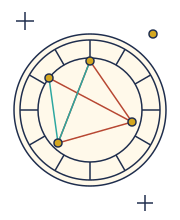
Astrologers agree that the 4th house belongs to home and roots, then disagree about almost everything else—especially which parent it describes. This study compares those competing claims with the early life a participant reports.
What in a chart describes the home and childhood someone actually experienced?
Phase 1 · Preliminary113 of 400 charts
Submit Your Chart →Free · one participant profile · findings shared as each phase completes
Methodology
The study separates claims about the childhood home, parental attribution and chart personalization rather than treating them as one broad reading.
01
The Childhood
How much of the childhood home does the 4th house describe: settled or restless, safe or turbulent, frequently moved or deeply rooted? This is the most direct claim under examination.
Significators examined
The 4th house and its ruler
Benefics and malefics in the 4th
The Moon’s condition, security and belonging
Mutable versus fixed signs on the IC, moving versus settled
02
The Open Question
Which parent does the 4th house signify? Rather than assume an answer, the study compares competing traditional claims with the people who actually raised the participant.
Claims compared
The 4th versus the 10th house
The Moon as nurture versus Saturn and the Sun
Each traditional parental attribution tested rather than assumed
03
The Real Chart
Does the true birth chart perform better than plausible incorrect charts? This isolates whether correct birth data adds information beyond common patterns and base rates.
The comparisons
The participant’s real chart
Matched sham charts scored by the same rules
A base-rate baseline as a non-astrological control
Why this is measurable: The study does not decide in advance that one parent belongs to the 4th house. It records who raised the participant and who shaped them most, then lets the competing astrological claims face the same answers.
The questionnaire
What You’ll Be Asked
Answer from your life as you remember it, not from what your chart or a previous reading says should be true.
01
Describe how safe, stable and settled your childhood home felt.
02
Identify the caregivers who raised you and the relationships you had with them.
03
Record major changes in home or family life, including the year that changed it most.
The findings
Results in Three Phases
The analysis becomes more precise as the sample grows. Every phase keeps the misses.
Phase 1 Now filling
Preliminary
A first look at the signal once 400 charts are in. Early results, wide uncertainty, published openly.
Phase 2
Expanded
The analysis runs again at 2,500 charts, with tighter estimates and checks on what survived Phase 1.
Phase 3
Full
The complete analysis at 5,000 charts, including what worked, what failed and what remains uncertain.
How it stays honest
How We Keep It Honest
Blind first. The chart is calculated and its predictions about childhood are recorded before anyone reads the participant’s answers.
Contested claims are tested, not assumed. Where astrologers disagree about which parent the 4th house rules, the competing versions are checked instead of selecting one in advance.
Misses published. The findings include where these significators fail.