
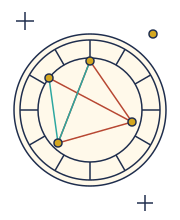
Aspects are geometric relationships between planets or important points in an astrology chart. They show which parts of the chart can see, support, challenge, combine with, or oppose one another.
The five major aspects are:
- Conjunction: 0 degrees
- Sextile: 60 degrees
- Square: 90 degrees
- Trine: 120 degrees
- Opposition: 180 degrees
The angle tells you the type of relationship. The planets tell you what is relating. Their signs, houses, rulerships, and condition tell you how and where the relationship is likely to operate.
An aspect is therefore not a complete interpretation. “Moon square Saturn” is the beginning of a judgment, not the end.
Astrology Aspects At A Glance
| Aspect | Angle | Signs apart | Traditional quality | Basic dynamic |
|---|---|---|---|---|
| Conjunction | 0° | Same sign or region | Depends on planets | Merger, concentration, co-presence |
| Sextile | 60° | 2 signs | Venus-like | Opportunity, exchange, cooperation |
| Square | 90° | 3 signs | Mars-like | Friction, action, pressure, conflict |
| Trine | 120° | 4 signs | Jupiter-like | Support, flow, reinforcement, ease |
| Opposition | 180° | 6 signs | Saturn-like | Polarity, confrontation, separation, culmination |
“Signs apart” is counted by the distance between signs, not by including the starting sign. Aries and Gemini are two signs apart and form a sextile relationship; Aries and Cancer are three signs apart and form a square.
What Does An Aspect Describe?
Each planet represents a set of functions. An aspect describes how two functions are connected.
For example:
- The Moon can signify the body, needs, care, habit, family, and change.
- Saturn can signify limits, duty, time, endurance, fear, and exclusion.
- A square connects them through friction and pressure.
Moon square Saturn might describe tension between emotional needs and duty, care structured by obligation, periods of scarcity that require endurance, or a serious and contained emotional style. Its actual expression depends on the signs, houses, sect, rulerships, exactness, and other testimonies.
The same aspect can describe a challenge, a developed skill, a circumstance, or several of these at once. Context decides.
The Conjunction: Planets Acting Together
A conjunction occurs when planets occupy the same degree or nearby degrees. Traditional authors sometimes treated conjunction as bodily co-presence rather than an aspect in the strict sense, because the planets are together rather than looking across an angle.
Conjunctions blend and intensify. Whether the combination is supportive or difficult depends heavily on the planets.
- Venus conjunct Jupiter may combine pleasure, agreement, growth, generosity, or excess.
- Mars conjunct Saturn may combine acceleration with restraint, force with resistance, or disciplined effort.
- Mercury conjunct the Sun can concentrate thought and identity, while the planet's visibility and distance from the Sun add traditional considerations.
Do not assume that conjunction means harmony. It means the planets cannot operate independently.
The Sextile: An Available Opportunity
A sextile connects signs that generally share compatible polarities but belong to different elements. It is traditionally associated with Venus and tends to describe workable exchange, sympathy, or opportunity.
Sextiles often require participation. They may describe a door that can be opened rather than an automatic result.
Mercury sextile Mars can support decisive speech, technical problem-solving, or a quick connection between thought and action. It can also sharpen arguments. The planets' condition determines what is available and how constructively it is used.
The Square: Friction That Demands Action
A square connects signs of the same modality (cardinal, fixed, or mutable) but incompatible elements. It is traditionally associated with Mars.
Squares describe tension, obstruction, competition, effort, and the need to act. They are often experienced as difficult because neither planet can simply ignore the other.
But “difficult” does not mean useless. A square can produce competence through repeated pressure. Mars square Mercury may correlate with argument, haste, or cutting speech, but it can also support debate, investigative thinking, and the ability to make decisions under pressure.
The question is not whether a square is secretly good. The question is what the friction produces and what resources the planets have for handling it.
The Trine: Reinforcement And Ease
A trine connects signs of the same element. It is traditionally associated with Jupiter and usually describes support, flow, familiarity, and reinforcement.
Venus trine Jupiter may make pleasure, affection, generosity, aesthetics, or social opportunity easier to access. Saturn trine Mercury can support disciplined thought, planning, or durable technical skill.
Ease is not identical to virtue. A trine can reinforce avoidance, entitlement, passivity, or an unexamined habit just as easily as it supports talent. Charles E. O. Carter cautions against treating a favorable aspect as automatically producing favorable conduct or outcomes.
The Opposition: Encounter Across A Polarity
An opposition joins signs across the zodiac. They share a modality but occupy opposite elements and complementary poles. Traditional astrology associates the opposition with Saturn.
Oppositions can describe confrontation, projection, awareness through another person, separation, negotiation, or culmination. The planets face one another and demand a relationship across distance.
Sun opposite Moon, for example, is the Full Moon phase. In a natal chart it can describe a strong polarity between purpose and instinct, visibility and privacy, or paternal and maternal significations. It does not automatically mean the parents were enemies or the person is permanently divided.
What Is An Orb?
An orb is the distance permitted between a planet's actual position and an exact aspect.
If Mercury is at 14° Aries and Mars is at 16° Cancer, their exact 90-degree square is two degrees from perfect. The aspect has a two-degree orb.
Astrologers disagree about allowable orbs. Common modern practice gives wider orbs to the Sun and Moon, narrower orbs to minor aspects, and more weight to tight contacts. Traditional methods may use whole-sign configurations, planet-specific moieties, degree-based application, or other rules.
Use consistent orbs for your chosen technique. Close contacts deserve priority; wider contacts provide context without replacing the chart's strongest configurations.
Applying Vs. Separating Aspects
An aspect is applying when the faster planet is moving toward exactness. It is separating when the faster planet has passed the exact angle and is moving away.
Traditional astrologers often give applying aspects more emphasis for matters developing or coming into form, while separating aspects can describe what has already occurred or is moving toward resolution.
Retrogradation and planetary stations can complicate this. A planet may apply, station before perfection, move away, and later return. Software can calculate the geometry, but the astrologer still needs to understand which body is moving toward which.
Whole-Sign Aspects Vs. Degree-Based Aspects
In Hellenistic astrology, signs themselves have configured relationships. Every degree of Aries has a whole-sign square relationship with Cancer, even if two planets in those signs are far from an exact 90-degree contact.
Degree-based exactness adds specificity and strength. This creates two layers:
- Whole-sign configuration: the planets occupy signs capable of seeing one another through a major aspect.
- Degree-based aspect: the planets are close enough to the exact angle to form a tighter contact.
Chris Brennan discusses whole-sign configurations and degree-based aspects in Hellenistic Astrology. Demetra George traces the historical aspect doctrine and its use in assessing planetary relationships in Ancient Astrology in Theory and Practice.
Modern chart software usually emphasizes degree-based aspects, sometimes without showing the broader sign relationship.
What Does “Aversion” Mean?
Signs that do not form a conjunction, sextile, square, trine, or opposition were traditionally said to be in aversion: they do not behold or witness one another through a major configuration.
The 30-degree and 150-degree relationships now called the semi-sextile and quincunx connect signs that were classically averse. Modern astrology often interprets the quincunx as adjustment, incompatibility, or strain. That is a later aspect framework and should be labeled as such rather than presented as identical to Hellenistic doctrine.
Major Vs. Minor Aspects
The five major aspects provide the best starting vocabulary. Modern astrologers also use minor aspects:
| Aspect | Angle | Common modern interpretation |
|---|---|---|
| Semi-sextile | 30° | Subtle adjustment or adjacent difference |
| Semi-square | 45° | Irritation or internal friction |
| Quintile | 72° | Creative organization or specialized ability |
| Sesquiquadrate | 135° | Persistent tension or pressure |
| Quincunx | 150° | Incongruity, adjustment, lack of common ground |
Adding more aspects increases the number of patterns in every chart. Learn the major aspects first, then add minor ones when they clarify a question rather than crowding the reading.
How To Interpret An Aspect Step By Step
Use this order:
1. Name The Two Planets
Translate each planet into functions, people, and topics without deciding the outcome yet.
2. Name The Relationship
Is it a merger, opportunity, friction, support, or polarity? Keep the aspect's geometry separate from the planets' meanings.
3. Read The Signs
The signs show how each planet operates and whether it has dignity, debility, elemental compatibility, or shared modality.
4. Read The Houses
The houses show where the relationship appears. Moon square Saturn across the fourth and seventh houses may connect home and family obligations with partnership. Across the second and eleventh it may connect resources with friends, patrons, or long-term hopes.
5. Follow The Rulerships
Each planet carries the topics of the houses it rules. An aspect can connect four or more houses: the two occupied houses plus the houses ruled by each planet.
6. Assess Condition And Exactness
Ask whether the planets are supported, angular, visible, direct, in sect, and close to exact. A strong planet has more capacity to deliver its significations.
7. Look For Repetition
One aspect is a sentence. Repeated house, ruler, and timing themes create the paragraph.
Natal Aspects Vs. Transiting Aspects
A natal aspect is part of the birth chart and describes an enduring relationship between planetary functions.
A transiting aspect forms when a currently moving planet contacts a natal planet or another transiting planet. It describes a temporary activation or current sky condition.
For example, natal Venus square Saturn is a baseline pattern in the chart. Transiting Saturn square natal Venus is a period during which Venusian topics may encounter Saturnian pressure or consolidation. The transit does not permanently add a new natal aspect.
Aspect Patterns
Three or more planets can form larger structures:
- T-square: two planets in opposition both square a third.
- Grand trine: three planets form a triangle of trines, usually in one element.
- Grand cross: two oppositions connected by four squares.
- Yod: two planets in sextile both quincunx a third, used mainly in modern astrology.
Patterns can make a planetary network more prominent, but their meaning still comes from the actual planets, signs, houses, and rulers. The shape is not a substitute for interpretation.
Common Aspect-Reading Mistakes
“Squares Are Bad And Trines Are Good”
Squares create friction; trines create ease. Either can be constructive or destructive depending on what is being made easier or pressured.
Ignoring Houses And Rulerships
Planetary psychology alone cannot tell you where the aspect manifests or which concrete topics it connects.
Using Enormous Orbs
Wide orbs make charts look busier and increase accidental matches. Prioritize close aspects and use a consistent policy.
Reading Every Aspect At Equal Volume
Tight aspects involving the Sun, Moon, chart ruler, angles, and activated time lords usually deserve attention before a loose minor aspect between two outer planets.
Treating One Aspect As A Diagnosis
No aspect, including combinations involving Saturn, Neptune, Pluto, or the Moon, can diagnose a mental-health condition, abusive relationship, or inevitable event.
Frequently Asked Questions
What Is The Strongest Aspect In Astrology?
There is no universal winner. Conjunctions are concentrated, oppositions and squares are forceful, and exact aspects to angles or important rulers can be highly prominent. Strength depends on exactness, planetary condition, angularity, and the question being asked.
Are Aspects More Important Than Signs?
They answer different questions. Signs describe how planets operate; aspects describe how planets relate. Houses and rulerships locate that relationship in life.
Do Aspects Change?
Natal aspects remain fixed. Transiting, progressed, and directed aspects change over time and can activate natal configurations.
Does A Chart Need Exact Birth Time For Aspects?
Interplanetary aspects can usually be calculated without an exact time, although the Moon may move substantially during the day. Aspects to the Ascendant, Midheaven, house cusps, and sometimes the Moon require reliable timing.
Astrology Sources And Further Reading
- Charles E. O. Carter, The Astrological Aspects, especially the introduction and planet-pair delineations.
- Demetra George, Ancient Astrology in Theory and Practice, Volume One (Rubedo Press, 2019), historical overview and chapters on whole-sign and degree-based aspects.
- Chris Brennan, Hellenistic Astrology: The Study of Fate and Fortune (Amor Fati Publications, 2017), chapter 9 on configurations.
- Stephen Arroyo, Chart Interpretation Handbook, aspect interpretation and chart-synthesis sections.