
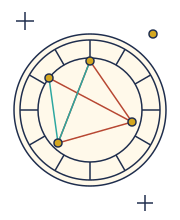
Astrology is the practice of interpreting relationships between celestial cycles and life on Earth. It uses the observed positions of the Sun, Moon, planets, and other astronomical points to construct charts for particular moments, then interprets those charts through a symbolic system developed across many cultures and historical periods.
The calculation and the interpretation are different layers:
- Astronomy supplies the positions and cycles.
- Astrology assigns those positions symbolic meaning.
A planet's location can be calculated. Its meaning for a person, event, or period is developed through interpretation, with different astrological traditions emphasizing different layers.
What Does Astrology Study?
Astrologers study charts cast for specific moments. The most familiar is the natal chart, calculated for a person's birth time and place. Other charts can be cast for events, questions, relationships, elections, nations, or the current sky.
Most Western astrology charts combine four basic components:
- Planets: what is acting
- Signs: how it acts
- Houses: where in life it acts
- Aspects: how the planets relate to one another
Planetary rulers connect these components. Timing techniques, including transits, annual profections, solar returns, progressions, and directions, ask when particular parts of a chart become more active.
The Planets: The Actors
In astrology, “planet” is a functional category rather than a strict astronomical one. The Sun and Moon are called planets or luminaries within astrological practice even though astronomers classify them differently.
The seven traditional planets and their broad significations are:
| Planet | Common astrological functions |
|---|---|
| Sun | Vitality, visibility, authority, purpose |
| Moon | Body, needs, habit, care, change |
| Mercury | Speech, thought, trade, analysis, messages |
| Venus | Union, pleasure, beauty, value, agreement |
| Mars | Action, heat, conflict, severing, courage |
| Jupiter | Growth, protection, faith, counsel, abundance |
| Saturn | Limits, duty, time, endurance, exclusion |
Modern Western astrology also uses Uranus, Neptune, and Pluto, often associating them with disruption and liberation, imagination and diffusion, and power and deep transformation.
These keywords are only starting points. A planet's sign, house, aspects, sect, rulership, speed, visibility, and other conditions modify how it can operate.
The Zodiac Signs: The Style Of Action
The zodiac is a twelve-part coordinate system along the ecliptic, the Sun's apparent annual path around Earth. Each sign occupies 30 degrees of zodiacal longitude.
Western astrologers commonly use one of two zodiacs:
- Tropical zodiac: begins Aries at the March equinox and remains tied to the seasons.
- Sidereal zodiac: adjusts zodiacal positions against a stellar reference, using an offset called an ayanamsa.
The twelve zodiac signs are not identical to the twelve astronomical constellations bearing similar names. Constellations vary in size; astrological signs are twelve equal 30-degree divisions.
Signs describe the manner or environment through which a planet acts. Mars still signifies Mars-like functions in every sign, but Mars in Capricorn is operating under Saturn's rules while Mars in Cancer is operating under the Moon's.
The Houses: Areas Of Life
The twelve houses organize the chart into life topics, including body and identity, resources, siblings and communication, home, children and pleasure, illness and labor, partnership, shared resources, religion and higher learning, career, friends, and isolation.
Houses depend on the chart's time and location. An accurate birth time is therefore especially important for the Ascendant, Midheaven, house cusps, and house rulers.
An empty house is not inactive. Its ruling planet carries its topics elsewhere in the chart.
For example, if Taurus is on the seventh house, Venus manages partnership matters. Venus's sign, house, aspects, and condition describe how and where those matters connect with the rest of life.
The Aspects: Relationships Between Planets
Aspects are angular relationships between planets or chart points. The major aspects are the conjunction, sextile, square, trine, and opposition.
They do not divide neatly into “good” and “bad.” A trine can show an easy capacity that is taken for granted; a square can describe friction that develops strength or forces action.
Charles E. O. Carter argues throughout The Astrological Aspects that no aspect should be interpreted apart from the planets, signs, houses, and other conditions involved. A chart is a network, not a bag of independent personality adjectives.
What Is A Birth Chart?
A birth chart is a map of the sky calculated for a particular date, clock time, and location. It shows:
- The zodiacal position of each planet;
- The rising sign and Ascendant degree;
- The Midheaven;
- Twelve houses;
- Aspects among planets and angles;
- The planetary rulers connecting the houses.
Astrologers do not all ask the same questions of that map. A traditional astrologer might begin with planetary condition, house topics, and time lords. A psychological astrologer might emphasize motivation, conflict, and integration. An evolutionary astrologer may emphasize developmental themes, habitual patterns, and perceived direction of growth.
Those approaches can overlap, but their assumptions should be labeled rather than blended invisibly.
The Main Branches Of Astrology
Astrology is not one technique. Major branches include:
Natal Astrology
Interprets the chart of a person's birth, usually for character, life topics, and timing.
Mundane Astrology
Studies nations, leaders, collective events, political cycles, ingress charts, and other public matters.
Horary Astrology
Casts a chart for the moment a specific question is received and understood, then judges that chart for an answer.
Electional Astrology
Chooses a time to begin an action, such as a marriage, launch, trip, or business, based on the chart of the proposed beginning.
Medical Astrology
Historically connected planets and signs with the body, illness, and treatment timing. It should not replace qualified medical diagnosis or care.
Relationship Astrology
Compares charts through synastry, composite charts, and timing to study relationship dynamics. Sun-sign compatibility is only the simplest and least specific version.
Traditional, Psychological, And Evolutionary Astrology
These tags describe interpretive lenses, not levels of accuracy.
Traditional astrology draws on premodern techniques, including planetary sect and dignity, whole-sign houses, lots, time lords, horary, and electional rules. Chris Brennan's Hellenistic Astrology and Demetra George's Ancient Astrology in Theory and Practice document and reconstruct major parts of this approach.
Psychological astrology focuses on inner dynamics, temperament, needs, conflict, and integration. Stephen Arroyo's Chart Interpretation Handbook is a practical example of modern chart synthesis in this style.
Evolutionary astrology treats the chart as a story of development, often using Pluto, the lunar nodes, and repeated psychological patterns to discuss growth and direction. Schools within evolutionary astrology differ significantly, so the label should not be treated as one standardized method.
How Does Astrology Work?
Astrological traditions understand the relationship between the sky and human life in different ways.
Historical astrology often understood celestial and terrestrial events as parts of an ordered cosmos connected through qualities, cycles, signs, and correspondences. Some modern astrologers propose causal forces. Others use Carl Jung's idea of synchronicity, symbolic correlation without a known physical cause. Still others treat astrology as divination, a meaning-making practice, or a structured language for reflection.
These perspectives give astrologers different ways to understand the connection between celestial cycles and lived experience.
Why Do People Use Astrology?
People use astrology for different purposes:
- Learning a symbolic language for self-reflection;
- Identifying recurring life themes;
- Creating ritual or spiritual meaning;
- Choosing dates or studying periods of emphasis;
- Exploring relationships;
- Making predictions;
- Studying historical cosmologies and divination.
Your reason for studying astrology helps determine where to begin: natal interpretation for self-understanding, synastry for relationships, or timing techniques for unfolding life chapters.
How To Start Learning Astrology
Begin with one coherent framework:
- Learn the seven traditional planets.
- Learn the twelve signs as modes of planetary expression.
- Learn the twelve houses as concrete life topics.
- Learn traditional rulerships.
- Read the Ascendant and its ruler.
- Add the Sun and Moon.
- Study the five major aspects.
- Practice synthesis before adding more points and techniques.
- Keep notes on recurring chart themes.
- Revisit those themes as your understanding develops.
The goal is to move beyond isolated keywords and understand how the parts of a chart work together.
Frequently Asked Questions
Is Astrology The Same As Astronomy?
No. Astronomy studies celestial objects and the physical universe. Astrology interprets their positions and cycles through signs, houses, aspects, and other symbolic relationships.
Is Astrology Only Your Sun Sign?
No. Sun-sign columns use one placement. A full chart includes the Moon, planets, Ascendant, houses, rulers, and aspects.
Do You Need An Exact Birth Time?
You need an accurate time to calculate the Ascendant, Midheaven, and houses reliably. Without it, many planetary signs and aspects remain available, but the chart is less specific.
Does Astrology Predict Fate?
Schools disagree. Some traditional astrologers make concrete predictive judgments; many modern astrologers emphasize tendencies, choices, and developmental periods. Any prediction should state its method, scope, and uncertainty.
Astrology Sources And Further Reading
- Chris Brennan, Hellenistic Astrology: The Study of Fate and Fortune (Amor Fati Publications, 2017), especially chapters 2 to 4 and 7 to 13.
- Demetra George, Ancient Astrology in Theory and Practice, Volume One: Assessing Planetary Condition, 2nd ed. (Rubedo Press, 2019).
- Stephen Arroyo, Chart Interpretation Handbook: Guidelines for Understanding the Essentials of the Birth Chart.
- Steven Forrest, The Inner Sky.
- Charles E. O. Carter, The Astrological Aspects.