
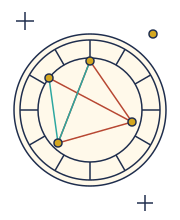
A birth chart can look like a wheel full of symbols competing for attention. The mistake is trying to interpret every symbol at once. A useful reading has an order: establish the chart's structure, identify its strongest themes, and only then combine the details.
The short version is:
- Confirm the birth data.
- Find the rising sign and chart ruler.
- Read the Sun and Moon.
- Identify the angular houses and their rulers.
- Place the planets by sign and house.
- Read the major aspects.
- Look for repetition before making a judgment.
That last step matters most. A chart is not a list of placements. It is a system in which multiple factors can describe the same underlying pattern.
1. Confirm The Birth Data
A natal chart is calculated for a date, time, and place. The date establishes the planetary positions. The location and clock time establish the local horizon and meridian, which determine the Ascendant, Midheaven, and houses.
If the time is uncertain, say so. The Moon may still be usable, depending on the day, but the rising sign and houses can shift. False precision is not interpretation.
2. Start With The Rising Sign
The Ascendant is the zodiacal degree rising on the eastern horizon at birth. In traditional astrology, it anchors the first house and is closely connected with the native's body, life, and circumstances. In modern astrology, it is also read as the way a person meets life and enters new situations.
Do not reduce it to a “mask.” The rising sign sets the architecture of the chart. Once it is known, you can identify the chart ruler, the planet that rules that sign.
For example:
- Aries or Scorpio rising: Mars rules the chart.
- Taurus or Libra rising: Venus rules the chart.
- Gemini or Virgo rising: Mercury rules the chart.
- Cancer rising: the Moon rules the chart.
- Leo rising: the Sun rules the chart.
- Sagittarius or Pisces rising: Jupiter rules the chart.
- Capricorn or Aquarius rising: Saturn rules the chart.
These are the traditional rulers, which preserve a complete seven-planet rulership scheme. Modern rulers can be added as a second layer, but they do not have to replace the traditional ruler.
3. Locate The Chart Ruler
Read the chart ruler by planet, sign, house, and condition.
Ask four questions:
- What does this planet do?
- How does its sign let it operate?
- Where, by house, does it spend its effort?
- What helps or strains it through aspects and traditional condition?
A Virgo rising chart, for example, is ruled by Mercury. Mercury in the tenth house ties the person's overall direction to work, visibility, reputation, or public contribution. Mercury in the fourth redirects that emphasis toward home, family, roots, or private foundations. The sign and aspects tell you how easily Mercury can carry that responsibility.
Chris Brennan discusses the domicile lord of the Ascendant as a major steering planet in Hellenistic Astrology (chapter 12). Stephen Arroyo likewise gives the Ascendant's ruler a central role in practical chart synthesis in Chart Interpretation Handbook (Ascendant and Midheaven section, especially the chart ruler discussion).
4. Read The Sun And Moon As A Pair
The Sun describes organizing purpose, vitality, and the drive to become fully oneself. The Moon describes bodily rhythms, needs, habits, memory, and instinctive responses.
Read each by sign, house, and aspect. Then compare them.
- Compatible elements may make purpose and instinct easier to coordinate.
- A hard Sun and Moon aspect can describe an ongoing negotiation between conscious direction and emotional habit.
- A shared house emphasis can make one life area carry both needs.
Neither luminary should be interpreted from sign alone. “Cancer Moon” is a starting category, not a complete judgment.
5. Read The Angles And Angular Houses
The first, fourth, seventh, and tenth houses are angular. They concern self and embodiment, home and foundations, partners and other people, and career or public role. Planets close to the Ascendant, Midheaven, Descendant, or IC often become louder in lived experience.
Next, examine the rulers of these houses. A house is not empty merely because it contains no planet. Its ruler carries its topics elsewhere in the chart.
If the seventh house is Taurus, Venus rules partnership matters. Venus's sign, house, and aspects describe how those matters are managed and where they connect with the rest of life.
6. Read Every Planet As A Sentence
A reliable formula is:
Planet = what acts. Sign = how it acts. House = where it acts. Aspects = what it must cooperate or contend with.
Mars in Libra in the sixth house is not simply “passive-aggressive.” Mars signifies assertion, severing, effort, conflict, and drive. Libra asks Mars to act through negotiation and balance. The sixth places that effort in labor, obligations, health routines, or subordinates. Aspects may show whether the strategy becomes disciplined, scattered, supported, or pressured.
This prevents one keyword from swallowing the rest of the chart.
7. Read Major Aspects In Context
Begin with conjunctions, oppositions, squares, trines, and sextiles. Note tight aspects to the Sun, Moon, chart ruler, and angles first.
Avoid treating trines as automatically good and squares as automatically bad. Charles E. O. Carter repeatedly warns in The Astrological Aspects that the same configuration can manifest differently depending on signs, houses, concurrent factors, and the condition of the planets involved. Ease can become complacency; friction can produce skill.
8. Synthesize By Repetition
Now ask what the chart says more than once.
Suppose career or public life is emphasized by:
- The chart ruler in the tenth house;
- The Sun near the Midheaven;
- The tenth-house ruler strongly placed;
- Several planets aspecting that ruler.
That is a pattern. One tenth-house placement is information; four independent testimonies form a theme.
Demetra George's Ancient Astrology in Theory and Practice, Volume One builds interpretation by assessing planetary condition before making a judgment. Arroyo's synthesis outline similarly moves from core structure toward integrated themes. Different traditions use different criteria, but both resist random keyword accumulation.
A Practical Reading Order
Use this checklist whenever a chart feels overwhelming:
- Data quality and house system
- Ascendant and chart ruler
- Sun and Moon
- Angular planets
- Angular-house rulers
- Element and modality emphasis
- Major aspects to the luminaries and chart ruler
- Repeated house or planetary themes
- Contradictions and compensating factors
- A three-sentence synthesis
Your final synthesis should explain the chart's central tension, its strongest resource, and the life areas where those dynamics are most visible.
Frequently Asked Questions
Can I Read A Chart Without A Birth Time?
Partly. You can usually read planetary signs and interplanetary aspects, but you may not be able to rely on the Ascendant, Midheaven, or houses. The Moon may also change signs on some dates.
Which House System Should A Beginner Use?
Whole sign houses provide a clear, historically grounded starting point. Placidus is also widely used, especially in modern practice. Learn one system consistently before comparing results.
What Is The “Big Three”?
The Sun, Moon, and rising sign. They are important, but a complete chart also includes the rulers, houses, aspects, and the condition of every planet.
Recommended Reading
Book links below are Amazon affiliate links. As an Amazon Associate I earn from qualifying purchases, at no extra cost to you.
- Demetra George, Ancient Astrology in Theory and Practice, Volume One: Assessing Planetary Condition, 2nd ed. (Rubedo Press, 2019), especially chapters on planets, signs, configurations, and synthesis.
- Chris Brennan, Hellenistic Astrology: The Study of Fate and Fortune (Amor Fati Publications, 2017), chapters 7 to 13.
- Stephen Arroyo, Chart Interpretation Handbook: Guidelines for Understanding the Essentials of the Birth Chart (CRCS Publications), especially the sections on the Ascendant, houses, aspects, and chart synthesis.
- Charles E. O. Carter, The Astrological Aspects.
Continue Learning
New to the subject? Start with What Is Astrology?. Then read What Is a Chart Ruler in Astrology?, What Do the 12 Houses Mean in Astrology?, and What Are Aspects in Astrology?.