
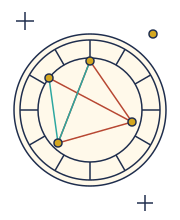
Composite Mars in the first house demands that the relationship be a complete expression of both people. Robert Hand says that should be true of any relationship and that it is even more important here.
His practical instruction follows immediately. It would be best if the two could find something they both like to do together, and the more physically active the better. There is a lot of energy in this relationship and it has to be expended somehow.
What This Placement Describes
The basic principle of Mars, in Hand's account, is the ego drive, the energy by which a person sustains a sense of being an individual both toward the world and toward other people. He argues that you build your notion of yourself through the ways you interact with others, and that without some kind of active inner energy you could not withstand encounters with others at all.
In a composite chart, Mars signifies the ability to create an environment within the relationship where both people can express themselves fully without threatening each other and provoking destructive conflicts. He is careful here rather than alarmist. Some conflict in a relationship is inevitable, and conflict as such should not be suppressed. What matters is that the ego drives are basically compatible, because otherwise nothing can be accomplished.
The first house is angular, which gives greater significance to any planet in it, and it is the persona of a relationship, showing the impression it makes on its surroundings and the extent to which the two are regarded as a unit in their own right. With Mars there, what the pair shows the world is drive.
How It Tends To Play Out
Hand describes the good outcome in terms of aim. If the two can find a common purpose, all of the energy will be focused on that instead of on each other. He says they will be able to accomplish a tremendous amount of work together and will enjoy each other in the process. There is no way around the fact, he adds, that this relationship demands activity.
That is the whole mechanism of the placement. The energy is a given. What is not given is where it points. A shared project, a shared physical activity, a shared job of work: any of these gives the Mars something to do.
Keeping the requirement in mind, Hand rates this an excellent placement for any relationship specifically aimed at accomplishing a job or task, such as a professional association. Where there is work to be done, the energy has its object built in.
The Opposite House
Hand's paired house rule comes from the mechanics of the composite. Two midpoints exist for any pair of planets, and although the nearer one is used, the farther one keeps some effect, an effect that increases as the two natal positions approach opposition. So a first house Mars should also be read through the seventh, and where the two natal Mars positions are near opposition, reading both is essential rather than optional.
The seventh is the house of intimate one to one encounter and of open enemies. Hand's reading of Mars there describes a relationship that either has a great sense of common purpose or a total conflict of purpose, with the outcome depending on finding something the two can do together, and he says the placement requires that the two be on an equal footing. Read as an axis, the first house is the energy as the world sees it and the seventh is what that energy does when the two turn and face each other. Both houses are angular, so both ends carry weight. Both also make the same demand, which is a shared object.
Hand gives no threshold for when the second reading takes over and no method for blending the two. Both stand.
Where It Gets Difficult
Hand names the failure mode, and his framing of it is worth following exactly. If the two do not handle these energies properly, Mars can signify fighting and conflict. But he immediately corrects the obvious reading of that. It is not that they necessarily dislike each other, although he allows that this could be the case. The problem is that the relationship does not give any relevance to the matters that are really important to each of them individually.
He puts the picture starkly. There are you, the other person, and your relationship, all of which seem to have very little in common. The conflict is a symptom of misdirected energy rather than a statement about how the two feel.
That diagnosis is also the remedy, because it points at what is missing rather than at either person. The relationship needs to be relevant to what each of them actually cares about. Where it is, the same energy that would otherwise turn inward gets spent on the work.
The house sets the issue. Whether the drive runs smoothly or roughly is described by the aspects to Mars, which is a separate question.
Recommended Reading
Book links below are Amazon affiliate links. As an Amazon Associate I earn from qualifying purchases, at no extra cost to you.
- Robert Hand, Planets in Composite: Analyzing Human Relationships (1975), chapter nine.
- Robert Hand, Planets in Composite: Analyzing Human Relationships (1975), chapter four, on the composite first house and the paired house rule.
Continue Learning
Next: Composite Chart Placements and How to Read a Composite Chart.