
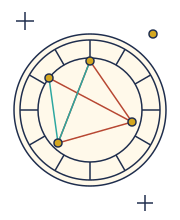
Composite Moon in the tenth house indicates a shared concern with getting ahead in life. Robert Hand puts it simply: both people want to get somewhere, and they feel that together they can do it better than they could separately.
He adds a traditional note that carries real weight here. The Moon in this house is associated with making a favourable impact on the public, so the pair's public image is likely to be good.
What This Placement Describes
Hand's general treatment of the composite tenth house sets career aside quickly. Career means little to a relationship unless the relationship is a business or professional one. What he keeps is the deeper sense of the house: development as something unique, and how that uniqueness gets established in the world. That is why the tenth also carries status and reputation, and why it describes direction and the main events of an evolution.
Applied to a composite, it is the uniqueness and evolutionary purpose of the relationship, both for the two people and for the world outside. A strong tenth-house relationship is more than normally concerned with where it is going, and the two will often ask what purpose it serves in their lives.
With the Moon there, that concern is felt rather than reasoned. The wish to get somewhere is part of the emotional fabric of the connection, and it is shared.
How It Tends To Play Out
Because of the favourable public impression, Hand says the potentials of this position can be exploited better by a professional relationship than by a personal one, though he is careful to add that it is quite good in either case. Two people with this placement tend to be well received together. Whatever they are doing, the outside world takes a warm view of it.
He also names a general strength. The tenth is angular, which gives the Moon strength and importance, and it lends the relationship a dynamic, active quality that can prevent stagnation. That is a real asset for the Moon, which in other houses can incline a relationship toward the comfortable and the static.
The Opposite House
The farther midpoint keeps some effect, and it grows as the two natal Moons approach opposition, so a tenth-house Moon should also be read through the fourth. Where the natal positions are near opposition, Hand treats reading both as essential.
The fourth house is the roots of a relationship, geographic and emotional, its innermost depths and its underlying compatibility. Hand calls the fourth the most natural position for the composite Moon because of its analogy with Cancer, which makes this axis a genuine tension rather than a simple complement. The tenth-house Moon looks outward and forward. The fourth asks what the relationship is like on the inside, whether the two share a background or a home, and whether there is anything at the bottom of it.
He offers no threshold at which the fourth-house reading takes over and no method for merging the two. Both are held.
Where It Gets Difficult
Hand asks for one factor to be kept in mind in a personal relationship, and it is the sharpest part of the delineation.
The tenth is an external house, dealing with matters that belong to the outside world. Having an important part of the chart there means the two tend to see things too much in terms of externals. He says the Moon is particularly damaged by that tendency, because the feeling side of a relationship should be an internal concern, something between the two people rather than outside them.
The specific form the danger takes is this. When problems arise, the two are likely to look to outside factors, the life situation, the jobs, the property, or whatever else is available, to explain what is happening between them. They may look out when they should look in. Or they may concentrate on externals and superficial matters and leave the internal ones untouched.
Hand does not present that as inevitable. He calls it a danger that has to be recognised and dealt with, and his overall verdict on the placement is favourable.
The house sets the issue. Whether the two turn their attention inward when it is needed is described by the aspects to the Moon, which is a separate question.
Recommended Reading
Book links below are Amazon affiliate links. As an Amazon Associate I earn from qualifying purchases, at no extra cost to you.
- Robert Hand, Planets in Composite: Analyzing Human Relationships (1975), chapter six.
- Robert Hand, Planets in Composite: Analyzing Human Relationships (1975), chapter four, on the composite tenth house and the paired house rule.
Continue Learning
Next: Composite Chart Placements and How to Read a Composite Chart.