
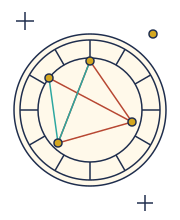
Composite Uranus in the sixth house is not the most congenial placement, and Robert Hand says why in one line. The sixth house in a composite chart represents the duties and responsibilities of a relationship, and Uranus, naturally rebellious, tends to rebel against all such impositions.
The most obvious effect is that obligations, whether to each other or to other people, are likely to become sources of disruption within the relationship. One or both will continually be in a state of rebellion against that side of things.
What This Placement Describes
Uranus in a composite chart is the planet of the unconventional and the unusual. Hand says it reveals alternate views of reality that help two people learn and grow, usually through a surprising upset. Handling it well means keeping a very open attitude and structuring life as little as possible. The house position shows where Uranus is most effective, and that area must be treated most gently, since forcing a Uranian characteristic to conform only produces disturbance.
The composite sixth house refers to the duties and responsibilities a relationship must fulfil. Hand is measured about it. All relationships have obligations and in most cases those obligations are not harmful. They become a problem only when they are the major element of the bond, leaving no room for the self expression ruled by the fifth. When the sixth is too strong, the two see the relationship as a duty to be met rather than something to be enjoyed. In a business relationship that is not a great problem, since there are tasks and obligations by definition.
How It Tends To Play Out
Hand offers a second and much more workable form of the same energy. It is possible that the two carry out their responsibilities in some very unusual way. Instead of being impatient about having to do what must be done, they are impatient about doing it in a particular manner.
His counsel for that version is practical. Each should let the other carry out the responsibilities in his or her own way, as long as the tasks get done. That separates outcome from method and gives Uranus the method to play with.
The placement is most helpful, he says, in a professional relationship involving scientific or technical work, or in any relationship where a new solution to a problem has to be found. One meaning of this placement is simply work carried out in a new or unusual way.
He then applies the same principle to personal relationships, and this is the constructive core of the delineation. The best aspects of a sixth house Uranus appear when the two always seek out new and unusual solutions to whatever problems they have with each other. The placement rewards invention applied to the relationship's own working difficulties.
The Opposite House
Hand's paired house rule comes from the mechanics of the composite. Any pair of planets has two midpoints. The nearer is used, but the farther keeps some effect, one that increases as the two natal positions approach opposition. So a sixth house Uranus should also be read through the twelfth, and where the two natal Uranus positions are near opposition, reading both is essential.
The twelfth house is repressed thought and the unconsciously motivated action that follows from it. Hand's Uranus in the twelfth describes a pair who send out disruptive energies without quite knowing it, often while appearing to go along with a situation they privately resent. Read as an axis, the sixth is the obligation openly carried and the twelfth is the resentment that never got stated, and the second reading explains a good deal about how the first goes wrong.
Hand gives no threshold for when the second reading takes over and no method for blending them. Both stand.
Where It Gets Difficult
The plain difficulty is that this placement makes routine obligation into contested ground. Every relationship has things that simply have to be done, and here those things attract friction rather than absorbing it. Hand describes a continual state of rebellion, which is a description of something ongoing rather than an episode.
The cost is not incompetence. It is that the ordinary machinery of a shared life takes more energy than it should, and that energy comes out of somewhere else.
What Hand offers instead of a warning is a redirection. The rebellion is against imposed method more than against duty itself, so the workable move is to stop imposing method. Let the tasks be done differently. Let the problems be solved in ways nobody would recommend. The general Uranus principle is the same: the area it touches has to be left freer than would otherwise be allowed, taking its own course with a minimum of expectations, because Uranus under pressure insists on doing everything the opposite way.
The house sets the issue. How the friction is handled is described by the aspects to Uranus, which is a separate question.
Recommended Reading
Book links below are Amazon affiliate links. As an Amazon Associate I earn from qualifying purchases, at no extra cost to you.
- Robert Hand, Planets in Composite: Analyzing Human Relationships (1975), chapter twelve.
- Robert Hand, Planets in Composite: Analyzing Human Relationships (1975), chapter four, on the composite sixth house and the paired house rule.
Continue Learning
Next: Composite Chart Placements and How to Read a Composite Chart.