
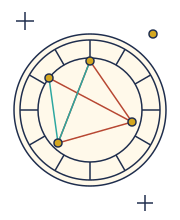
Mars in the fourth house of a composite chart is most noticeable when its energy is not working smoothly. Robert Hand makes that the organising fact of the delineation, and the positive half follows from it directly.
If the Mars energy is working smoothly, he says, the two will hardly be aware of it. They will work together with a natural rapport and an inherent smoothness. The drive is simply built into the foundation and does not have to be managed.
What This Placement Describes
The basic principle of Mars, in Hand's account, is the ego drive, the energy by which a person sustains a sense of being an individual toward the world and toward others. In a composite chart it signifies the ability to create an environment where both people can express themselves fully without threatening each other and provoking destructive conflicts. Some conflict is inevitable and should not be suppressed. What matters is that the ego drives are basically compatible.
The fourth house rules the innermost bases of life: the inner foundation, the home, the unconscious mind, parents and in laws. Hand stresses that it means more than the home, since many relationships have nothing that could be called one. It is angular, which adds significance, and it indicates the basic roots of a relationship both literally in geographic terms and figuratively in terms of mental and emotional background. He calls it the innermost depths of a relationship, which may be so far within as to be invisible at the surface.
It is also the house to check for underlying compatibility, whether the two have compatible backgrounds and whether their basic emotional and psychological characteristics fit.
How It Tends To Play Out
Because the fourth house is where a relationship's foundations sit, Mars there operates below the level the two people usually notice. The rapport Hand describes is not something either of them arranges. It is a matter of the drives lining up at a depth neither has to think about.
The effects, when they do become visible, are apparent in the most basic aspects of the two lives. Hand gives concrete instances. If the couple live together, the energy could show up as arguments in and about the home, or in differing concepts of what a home ought to be. If they are married, parents might be the immediate occasion for a battle.
His point about those instances is the useful one. Neither the home nor the parents is really the problem. They are simply where something deeper becomes visible.
The Opposite House
Hand's paired house rule comes from the mechanics of the composite. Two midpoints exist for any pair of planets, and although the nearer one is used, the farther one keeps some effect, an effect that increases as the two natal positions approach opposition. So a fourth house Mars should also be read through the tenth, and where the two natal Mars positions are near opposition, reading both is essential rather than optional.
The tenth is the reality of what a relationship is to the outer world, its status, its uniqueness and the direction of its evolution. Hand's reading of Mars there says the energy must be successfully expressed through the relationship or there is likely to be trouble, and that each person must be allowed room to follow their own path. Read as an axis, the fourth is the drive at the roots and the tenth is the drive as ambition and direction in the world. Both houses are angular, so both ends carry weight, and Hand's caution about the tenth, that neither should sacrifice their goals for the other, applies to the same energy that the fourth locates underground.
Hand gives no threshold for when the second reading takes over and no method for blending the two. Both stand.
Where It Gets Difficult
Where the energy is not running smoothly, Hand describes a specific kind of difficulty rather than a general one. The sources of ego conflict are buried deep within the relationship, so they are hard to root out and bring into the open. The causes lie in matters the two take so much for granted that they are not even aware of them.
His instruction follows from that. They must question even their most fundamental assumptions in order to discover how they are subverting the relationship. He states the underlying difficulty in one line: unconscious ideas and notions on various subjects become clear to you only when they are challenged.
That is why the arguments, when they happen, tend to be about the home or about parents. Those are the places where an unexamined assumption gets contradicted and becomes briefly visible. Hand says it will take a very deep inquiry into themselves to get at these problems, which is a real demand and not a small one.
The house sets the issue. Whether the drive at the roots runs easily or under friction is described by the aspects to Mars, which is a separate question.
Recommended Reading
Book links below are Amazon affiliate links. As an Amazon Associate I earn from qualifying purchases, at no extra cost to you.
- Robert Hand, Planets in Composite: Analyzing Human Relationships (1975), chapter nine.
- Robert Hand, Planets in Composite: Analyzing Human Relationships (1975), chapter four, on the composite fourth house and the paired house rule.
Continue Learning
Next: Composite Chart Placements and How to Read a Composite Chart.