
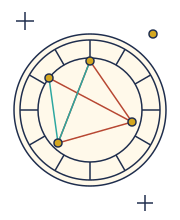
Mars in the third house of a composite chart puts the drive of the relationship into its daily mind, its opinions and its immediate surroundings. Robert Hand says the placement indicates several areas of expression at once, and he takes them in turn.
The third house rules the lower mind, meaning the mind in its routine day to day functioning, along with the immediate environment and relatives. Mars there makes all of that active territory.
What This Placement Describes
The basic principle of Mars, in Hand's account, is the ego drive, the energy by which a person sustains a sense of being an individual toward the world and toward others. In a composite chart it signifies the ability to create an environment where both people can express themselves fully without threatening each other. He allows that some conflict is inevitable and that conflict as such should not be suppressed, but insists the ego drives must be basically compatible.
The composite third house carries much the same meaning as in a birth chart: communication, mind, the routine day to day environment, and relatives. Hand says the communications side is especially important, because a couple who cannot communicate are in real trouble. He also describes the third as the house of the lower mind, carrying habitual patterns of thought, unquestioned opinions and unexamined notions, and he says these patterns tell a great deal about how a relationship will operate.
Mars in that setting means the daily mental life of the relationship carries a charge. Ideas are not idle here.
How It Tends To Play Out
Where the relationship is working, Hand gives a clear positive reading of the environmental side. The two will be actively and vigorously involved with their immediate family and relatives. The energy goes into the surrounding world of daily life, and it goes in with force.
The mental side works the same way. A relationship with a strong third house comes about through mental affinity, and Mars adds drive to that exchange. Ideas get pressed, tested and argued for. The two are not neutral about what they think, and being together makes them less neutral rather than more.
Hand attaches a requirement to the placement, and it is a demanding one. The two have to straighten out within themselves and with each other what is going on inside them. In his words, they have to have great self awareness. That is the maintenance this position asks for.
The Opposite House
Hand's paired house rule comes from the mechanics of the composite. Two midpoints exist for any pair of planets, and although the nearer one is used, the farther one keeps some effect, an effect that increases as the two natal positions approach opposition. So a third house Mars should also be read through the ninth, and where the two natal Mars positions are near opposition, reading both is essential rather than optional.
The ninth house is the overall view of the world the two people take, their collective attitudes and the nature of their intellectual exchange. Hand's reading of Mars there describes a strong involvement with ideas, beliefs and philosophies, hard work to protect compatible attitudes, and where the attitudes are not compatible, energy spent trying to convince each other. Read as an axis, the third is the daily opinion and the ninth is the belief system that opinion belongs to. The pairing is unusually direct, because both ends concern the mind under pressure.
Hand gives no threshold for when the second reading takes over and no method for blending the two. Both stand.
Where It Gets Difficult
Hand names the mechanism precisely, and it is more interesting than a simple prediction of argument. Where the two are not getting along well, this placement signifies arguing, disputes and general intellectual disagreement. The reason he gives is that each person may identify with their own ideas and opinions so strongly that a challenge to their beliefs feels like a challenge to their innermost self.
That is the whole problem in one sentence. It is not that the ideas matter too much. It is that the ideas have been fused with identity, so a disagreement about a subject becomes a defence of the self. Habits and other ingrained behaviour patterns can become an issue in the same way.
The environmental side has a matching negative turn. If events take that direction, the two may be constantly at odds with their immediate surroundings, with continual disputes with relatives as his example. Hand's remedy is the same in both cases, which is that both must watch out for unconscious habits of thought.
He adds elsewhere that the only way to deal with such patterns is to have a neutral third party help bring them into the light, because people are often not even aware of their own habitual attitudes.
The house sets the issue. Whether the exchange runs sharp or easy is described by the aspects to Mars, which is a separate question.
Recommended Reading
Book links below are Amazon affiliate links. As an Amazon Associate I earn from qualifying purchases, at no extra cost to you.
- Robert Hand, Planets in Composite: Analyzing Human Relationships (1975), chapter nine.
- Robert Hand, Planets in Composite: Analyzing Human Relationships (1975), chapter four, on the composite third house and the paired house rule.
Continue Learning
Next: Composite Chart Placements and How to Read a Composite Chart.