
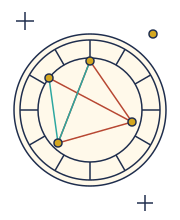
Mercury in the fifth house of a composite chart indicates that as a couple the two are drawn to intellectual modes of recreation and self-expression. Robert Hand's description is unusually concrete. They enjoy talking to each other, not only to communicate what has to be said but because they genuinely enjoy talking.
The fifth is the house of enjoyment. With Mercury there, the enjoyment is largely mental.
What This Placement Describes
Hand's general treatment of the composite fifth house is more searching than the traditional topic list suggests. The fifth shows how far a relationship gives two people room to be themselves in the most genuine and honest way they can manage. Many relationships survive only because each person keeps up a false front, and when the truth arrives those relationships collapse. The fifth signifies the ability to be real in each other's presence, and he insists that being real should not take effort.
He also says a strong fifth house means a relationship very concerned with self-expression, where two people are together because they enjoy being themselves in each other's company rather than to form a team.
Mercury there gives that self-expression a mental form. What the two do together, and what they enjoy, is thinking and talking. Hand notes that they both enjoy conversation with others as well, and names activities: the theatre, concerts, or simply being together and reading good books.
How It Tends To Play Out
The fifth house also governs children and their education, and Hand gives that a full paragraph. If the two have children, they will pay close attention to their education, making sure the right opportunities and the right influences are in place. His caution is to avoid educating children intellectually to the point of neglecting their emotional growth, since they have to learn to be complete individuals.
The other consequence he draws concerns attraction. A fifth-house Mercury indicates that what draws the two together is at least partly intellectual affinity. He is careful about the limits of the claim. The placement does not say whether their thinking is similar at all levels. What it does say is that they should enjoy intellectual compatibility, and since easy communication is one requirement of a successful personal relationship, they have an excellent start.
The Opposite House
The farther midpoint keeps some effect, and it increases as the two natal Mercurys approach opposition, so a fifth-house Mercury should also be read through the eleventh. Where the natal positions are near opposition, Hand treats reading both as essential.
The eleventh house is friendship, hopes and shared ideals. Hand's delineation of Mercury there describes a hopeful outlook, plans made together, and friends who bring new ideas into the shared life, along with similar intellectual goals. Read as an axis, the two houses cover enjoyment from two directions. The fifth is talk for its own sake, in the present. The eleventh is talk about what the two want and where they are going. Hand assigns friendship to both houses, so the overlap is real and acknowledged in his own text.
He gives no threshold for when the eleventh reading takes precedence and no formula for combining them. Both are read.
Where It Gets Difficult
Hand attaches no warning to this placement beyond the one about children's emotional growth, and it is more honest to note that than to manufacture a failure mode.
What the surrounding material makes visible is the limit of intellectual affinity as a foundation. The placement establishes that the two enjoy each other's minds. It does not establish that they think alike where it counts, and Hand says as much. A relationship can start on the pleasure of good conversation and later discover that the agreement never went below the level of enjoying the exchange.
The wider fifth-house character applies too. This is not a position of partnership. Two people here are together and still individuals, and the staying power for a long shared project has to come from elsewhere in the chart.
The house sets the issue. How the two handle it is described by the aspects to Mercury, which is a separate question.
Recommended Reading
Book links below are Amazon affiliate links. As an Amazon Associate I earn from qualifying purchases, at no extra cost to you.
- Robert Hand, Planets in Composite: Analyzing Human Relationships (1975), chapter seven.
- Robert Hand, Planets in Composite: Analyzing Human Relationships (1975), chapter four, on the composite fifth house and the paired house rule.
Continue Learning
Next: Composite Chart Placements and How to Read a Composite Chart.