
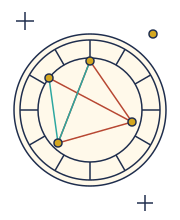
The key idea of Mercury in the tenth house of a composite chart is consciousness of life direction or purpose. Robert Hand takes this to mean that both people have a very strong sense of purpose within the relationship, and that at the very least they will discuss and think about their aims a great deal.
He is careful about what the placement will not tell you. Mercury in the tenth says little about what that purpose actually is. It says that the question will be important.
What This Placement Describes
Hand's general treatment of the composite tenth house sets career aside almost immediately, since career means little to a relationship unless the relationship is a business or professional one. What he keeps is the deeper meaning: development as something unique, and how that uniqueness gets established in the world. Hence status and reputation, and hence the house's connection with the direction of an evolution and the main events of that process.
In a composite, that becomes the uniqueness and evolutionary purpose of the relationship, for the two people and for the world outside it. A strong tenth-house relationship is more than normally concerned with direction, and the two will often ask what purpose it serves in their lives.
He also distinguishes the tenth from the eleventh cleanly. The tenth is not ideals and hopes, which belong to the eleventh. Its issues are plans likely to be realised, because they are the real intention of the relationship. With Mercury there, those plans get thought about and talked over continuously.
How It Tends To Play Out
For a business or professional relationship, Hand suggests the two will work together successfully in fields such as communications, transportation, education or writing.
In a personal relationship nothing so specific is implied. What he says instead is that communication at every level will be important in fulfilling whatever purpose brought the two together. There will be a strong intellectual bond between them. They will enjoy sitting and talking and sharing their ideas with each other, and the more they do it, the more they grow as a couple.
His closing statement for the placement is the strongest part of it. Through reason, logic, communication and thought, the functions of Mercury, the two will achieve their maximum growth as a couple. Talking things through is not incidental to this relationship. It is the mechanism by which it develops.
The Opposite House
Because the farther midpoint keeps some effect, and it grows as the two natal Mercurys approach opposition, a tenth-house Mercury should also be read through the fourth. Where the natal positions are near opposition, Hand treats reading both as essential.
The fourth house is the roots of a relationship, geographic and emotional, and its innermost depths, which may be invisible at the surface. Hand's delineation of Mercury there describes two people able to talk about their deepest feelings and about what is actually at the heart of the relationship, matters that would normally stay unconscious. Read as an axis, the pairing is complementary in a useful way. The tenth-house conversation is about direction and purpose. The fourth-house conversation is about what the relationship is made of underneath. A pair discussing their aims constantly may or may not be discussing the other thing.
He gives no threshold at which the fourth reading takes over and no method for blending the two. Both stand.
Where It Gets Difficult
Hand attaches no warning to this delineation, and the honest course is to say that rather than supply one.
The pressure that belongs to the house is his general caution about the tenth. It is an external house, and a heavy tenth-house emphasis inclines two people to see things too much in terms of externals, sometimes becoming excessively concerned with how they look to others while ignoring serious problems between them. With Mercury there, the version to watch for is a relationship that talks about direction fluently and thoroughly, and rarely turns the same attention on what is happening between the two people rather than in front of them.
The other quiet risk is that constant discussion of purpose can substitute for having one. Hand notes that the placement indicates the issue will be important, not that it is settled.
The house sets the issue. How the two handle it is described by the aspects to Mercury, which is a separate question.
Recommended Reading
Book links below are Amazon affiliate links. As an Amazon Associate I earn from qualifying purchases, at no extra cost to you.
- Robert Hand, Planets in Composite: Analyzing Human Relationships (1975), chapter seven.
- Robert Hand, Planets in Composite: Analyzing Human Relationships (1975), chapter four, on the composite tenth house and the paired house rule.
Continue Learning
Next: Composite Chart Placements and How to Read a Composite Chart.