
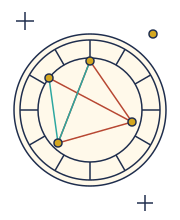
Composite Neptune in the seventh house asks two people to be very careful that they understand the true nature of what they are in, particularly where it is a partnership such as a marriage or a business. Robert Hand says the placement can make a relationship seem quite different from what it actually is.
What Neptune subverts here is specific. The seventh house is one to one relationship between equals, and equality is the thing Neptune is least able to leave alone.
What This Placement Describes
Neptune in a composite chart governs idealisation and the disappearance of things, and Hand connects them by saying that turning another person into a myth is the ordinary overshoot of a real attraction. When the truth arrives, bitter disappointment follows. He also credits Neptune with the wordless understanding a relationship needs, and warns that the same sensitivity, overdone, invents what is not there.
The composite seventh house, like the first, marks a relationship in which the two are genuinely trying to function as a unit. Hand says a strong and well aspected seventh helps any partnership survive, and that in a strong seventh house relationship the two are likely to think of themselves as one, as we and us. It is not simply enjoying each other's company, which belongs to the fifth. It is complementing each other and making a strong whole. He adds the other half of the traditional meaning without softening it. The seventh is also the house of open enemies, so a seventh house relationship that is badly aspected is still an intimate encounter, but the two may be competitors.
How It Tends To Play Out
The pattern Hand names here is the one he calls, borrowing another astrologer's phrase, the savior and victim. Regardless of the type of relationship, one position in it looks for someone to rescue them from their problems while the other looks for someone to save. His judgement is even handed and worth quoting in substance: both are in equally bad shape, because neither can relate on an equal, face to face level.
His illustration is the selfless spouse caring for a partner in serious trouble, apparently giving no thought to themselves. He says both parties are really getting what they want from the arrangement, because neither has to take on the responsibility of handling a normal relationship, which is what they actually need. A composite chart cannot say which person occupies which side, and Hand's method does not attempt to.
The second form is quieter. Each person may be dealing not with the other as a real person but with an ideal image formed inside themselves rather than out of any actual experience of the other. Hand says such a relationship is bound to end in major disappointment.
Against all of that he sets the other possibility, in the same paragraph. A seventh house Neptune can indicate a relationship that really does have powerful spiritual bonds, in which the two have a deep intuitive understanding of each other. What it requires is understanding and accepting the truth about themselves and each other.
The Opposite House
The paired house rule comes out of the mechanics of the composite. Any pair of planets has two midpoints, the nearer is used, and the farther keeps some effect that grows as the two natal positions approach opposition. So a seventh house Neptune should also be read through the first, and where the two natal Neptunes are near opposition, reading both is essential.
The composite first house is the persona of the relationship, the impression it makes rather than what it is. Hand's Neptune in the first carries the same danger that the two do not understand what the relationship is about, and adds that a first house Neptune deceives onlookers as well. Read as an axis, the seventh is what passes between the two and the first is what the arrangement looks like, and Neptune here can hold the appearance steady while the substance changes.
Hand gives no threshold for when the second reading takes over and no method for blending them. Both stand.
Where It Gets Difficult
The difficulty is that the rescue arrangement is stable. It supplies both positions with something, which is why it lasts and why it resists being named. Hand's objection is not that anyone is behaving badly. It is that the arrangement removes the equality the seventh house exists to provide.
The ideal image problem is harder still, because there is nothing visibly wrong until the image fails. Two people can be attentive, faithful and entirely mistaken about who they are with.
The same placement is where Hand allows for genuine intuitive partnership, and he does not treat that as the rare exception. The house sets the issue. Whether the handling runs easy or hard is described by the aspects to Neptune, which is a separate question.
Recommended Reading
Book links below are Amazon affiliate links. As an Amazon Associate I earn from qualifying purchases, at no extra cost to you.
- Robert Hand, Planets in Composite: Analyzing Human Relationships (1975), chapter thirteen.
- Robert Hand, Planets in Composite: Analyzing Human Relationships (1975), chapter four, on the composite seventh house and the paired house rule.
Continue Learning
Next: Composite Chart Placements and How to Read a Composite Chart.