
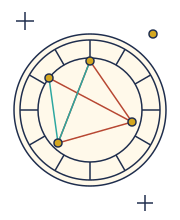
Composite Neptune in the sixth house points two ways at once. Robert Hand says the two people may hold a very high ideal of service to others, or they may be unclear about what they are supposed to be doing as a couple at all.
The sixth is the house of responsibilities, duties and work, and Neptune makes those a possible source of confusion. Hand also notes that a sixth house Neptune can mean the relationship has troubles whose origin is obscure, which is a Neptunian way for trouble to arrive.
What This Placement Describes
Neptune in a composite chart rules idealisation and the failure to see clearly, and Hand's key to the planet is that it is a totally selfless energy, not readily harnessed to the demands of the ego. The more a couple needs something to be a particular way, the more Neptune deludes them about it. That makes this house placement less awkward than most, and Hand says so directly. In many ways the sixth house is not a bad place for Neptune, because, like Neptune, it demands putting something else before your own wishes.
The composite sixth house is the duties and responsibilities the relationship has to fulfil. Hand is careful about it. Every relationship has obligations and they are usually not harmful. Duties become a problem only when they are the major element of a relationship, leaving no room for the self expression the fifth house rules. Where the sixth is too strong, the two see the relationship as a duty to be met rather than something to be enjoyed. In a business relationship that is no great problem, since there are tasks and obligations anyway. In a personal one it can weaken things over time. He adds that health, the other traditional sixth house meaning, has little relevance in a composite chart except where the relationship is professionally concerned with health.
How It Tends To Play Out
Work, or just plain getting things done, becomes something close to a philosophical ideal for a couple with this placement. That can be genuine and it can be productive. Hand's qualification arrives immediately after, and it is the load bearing sentence of the delineation. Every relationship must provide to some extent for each person's legitimate demand for self expression. Not everything can be done for some higher cause. Whether or not the two acknowledge them as such, their own needs are legitimate and have to be met.
The failure he describes when that is ignored is precise. If the two become too wrapped up in the ideal of service, whether toward each other or toward the world, it can produce a very subtle form of resentment in which one or both plays the martyr. Then every act of service comes with a bill attached, and the bill is presented in ways Hand calls not very subtle but difficult to deal with.
His closing line is permission rather than warning. If the ideal of service is sincere, fine. Just leave room in the relationship for what each person needs from it.
The Opposite House
The paired house rule comes out of the mechanics of the composite. Any pair of planets has two midpoints, the nearer is used, and the farther keeps some effect that grows as the two natal positions approach opposition. So a sixth house Neptune should also be read through the twelfth, and where the two natal Neptunes are near opposition, reading both is essential.
The composite twelfth is repressed thought, ideas pushed out of the waking mind, and the unconsciously motivated actions that follow. It is also Neptune's traditional house, and Hand says a twelfth house Neptune is relatively untroublesome, letting each person set aside their own demands when it really counts, while carrying the same martyr risk in its negative form. Read as an axis, the sixth is the work openly undertaken and the twelfth is whatever the two are not admitting about undertaking it.
Hand gives no threshold for when the second reading takes over and no method for blending them. Both stand.
Where It Gets Difficult
The difficulty is that martyrdom looks identical to devotion from the outside and often from the inside as well. Both involve one person doing a great deal. What separates them is whether an unpaid account is quietly accumulating.
The second difficulty is the confusion Hand names first, about what the couple is actually for. When the sense of purpose is vague, service is an easy thing to reach for, because it always supplies something to do. Doing is not the same as knowing what the relationship is.
Nothing here is a warning against generosity. Hand's own view is that the sixth house suits Neptune, provided both people's needs stay on the list. The house sets the issue. Whether the handling runs easy or hard is described by the aspects to Neptune, which is a separate question.
Recommended Reading
Book links below are Amazon affiliate links. As an Amazon Associate I earn from qualifying purchases, at no extra cost to you.
- Robert Hand, Planets in Composite: Analyzing Human Relationships (1975), chapter thirteen.
- Robert Hand, Planets in Composite: Analyzing Human Relationships (1975), chapter four, on the composite sixth house and the paired house rule.
Continue Learning
Next: Composite Chart Placements and How to Read a Composite Chart.