
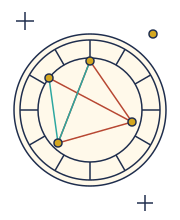
Robert Hand calls the fourth house a very important and critical position for Pluto in a composite chart. It indicates that powerful forces are at work in the innermost depths of the relationship.
He then says the actual effects can vary considerably, and gives four of them rather than one, which is a fair signal of how broad this house is in his hands.
What This Placement Describes
Pluto in a composite chart is the planet of death and regeneration, the energy that puts a relationship through heavy change so an order that has outlived its purpose can be replaced. Hand's handling rule is to let go of whatever is going through the crisis rather than trying to hold it. The power comes from within, because the transformations Pluto rules arise from the nature of what is transformed. The house position shows where power conflict is likeliest, which area will be most transformed by the two being together, and which is most likely to produce crises.
The composite fourth house is more than the home, and Hand makes the point directly, since many relationships have nothing that could be called a home while the fourth still matters. It is angular, which adds weight. It shows the roots of a relationship, literally in geographic terms and figuratively in terms of background, and it signifies the innermost depths, which may lie so far in as to be invisible at the surface. It is the house to check for underlying compatibility, and where there is a shared home, that home is the physical embodiment of the innermost life.
How It Tends To Play Out
The fourth house rules the past, so Hand's first reading is that past circumstances may have a stronger than usual conditioning effect on the course of the relationship.
It also rules the deepest levels of the unconscious mind, which gives the second. The two may act out very deep, unconsciously motivated patterns that change the direction of the relationship. Hand says it is very important to establish whether this is happening. Once it is clear that some of the problems come from the individuals' own mental patterns rather than from external events, the problems can be worked on.
The third reading concerns family. In a love relationship or marriage, one or more of the parents may have an unusual degree of influence. Hand adds an honest limit here that is worth keeping. From Pluto's house position alone one cannot tell whether that influence will be good or bad.
The fourth concerns the home itself. Where a relationship has a clearly recognisable home, very powerful forces may be experienced there, and Hand names the specific inconvenience. Home should be the place to get away from pressure, and with Pluto here it can be the place where pressure is most intense.
His closing note is not a warning. Whatever the effect, a fourth house Pluto provides for the resolution of its own problems, because it gives both the desire and the ability to get at the depths of one's own being. The only caution attached is not to carry that so far that all perspective is lost.
The Opposite House
The paired house rule comes out of the mechanics of the composite. Any pair of planets has two midpoints, the nearer is used, and the farther keeps some effect that grows as the two natal positions approach opposition. So a fourth house Pluto should also be read through the tenth, and where the two natal Plutos are near opposition, reading both is essential.
The composite tenth house is the direction and evolutionary purpose of a relationship and its standing in the world. Hand's Pluto in the tenth is a powerful energy oriented toward an objective, heightening ambition and altering the life direction of both people, with ruthlessness as its failure mode. Read as an axis, the fourth is the buried ground and the tenth is the public aim, and the intensity Hand describes at home and the drive he describes outward are the same energy at two ends.
Hand gives no threshold for when the second reading takes over and no method for blending them. Both stand.
Where It Gets Difficult
The difficulty is location. What is operating sits at the level of the relationship that is hardest to observe, which is why Hand puts so much weight on establishing whether unconscious patterns are driving events. Until that is settled, the two are likely to treat internal pressure as though it came from outside.
The home is the practical cost. A place that should discharge pressure instead concentrates it, and that is wearing in a way that is easy to misattribute.
Hand's own conclusion is the reason this is not a bleak placement. The same depth that produces the pressure supplies the capacity to reach it and work with it. The house sets the issue. Whether the energy is experienced as difficult or easy is described by the aspects to Pluto, which Hand treats as a separate question.
Recommended Reading
Book links below are Amazon affiliate links. As an Amazon Associate I earn from qualifying purchases, at no extra cost to you.
- Robert Hand, Planets in Composite: Analyzing Human Relationships (1975), chapter fourteen.
- Robert Hand, Planets in Composite: Analyzing Human Relationships (1975), chapter four, on the composite fourth house and the paired house rule.
Continue Learning
Next: Composite Chart Placements and How to Read a Composite Chart.