
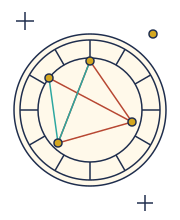
Composite Pluto in the third house indicates a relationship that has a profound effect on the thinking of both people. Robert Hand extends that outward as well. The two are then likely to have an impact on the thinking of the people around them.
What Pluto contributes to the third house is depth. Hand describes it as deep, profound thought whose purpose is to understand the forces lying behind events, which is a different activity from the everyday mental traffic the third house usually handles.
What This Placement Describes
Pluto in a composite chart is death and regeneration, the energies that carry a relationship through periods of heavy change so that a new order can replace one that has outlived its purpose. Hand says the power of Pluto comes from within, since the transformations it brings arise out of the nature of whatever is being transformed. In a relationship the energy is often experienced as power conflict, and the house Pluto occupies shows where that conflict is likeliest and which area will be most transformed by the two being together.
The composite third house holds communication, the mind, the routine day to day environment and relatives. Hand says the communication side matters most, because a couple who cannot communicate is in real trouble. He also describes the third as the house of the lower mind, the mind in its routine operation at a low level of consciousness, running on habitual patterns, unquestioned opinions and unexamined notions. Those patterns are very often a source of conflict, and because people are usually unaware of holding them he suggests a neutral third party can help bring them into the light. A relationship with a strong third house tends to come about through mental affinity, two people fond of talking with each other and exchanging ideas.
How It Tends To Play Out
In concrete terms, Hand expects the two to spend a considerable amount of time discussing the relationship itself and trying to analyse what makes it work. They will also look more deeply into themselves to find out why they act as they do inside a relationship. The end result of that introspection can be a considerable increase in understanding, of each other and of themselves.
The other side is the one he says should be minimised or avoided altogether. Because the third is a house of communication, Pluto here can mean that one or both of the two tries to mould the other's mind and thinking to fit their own beliefs. Hand is fair about how common that is. Most people do it to some extent. The danger specific to this placement is that the effort to convince becomes an all pervading concern, until the other person feels they are being brainwashed and that the only solution is to get out. He calls that obviously dangerous to the relationship.
The energy can also be turned outward, with the two making a career of influencing others to adopt their point of view. Hand permits this with a condition. Done with subtlety it is all right, but watch for a backlash.
The Opposite House
The paired house rule comes out of the mechanics of the composite. Any pair of planets has two midpoints, the nearer is used, and the farther keeps some effect that grows as the two natal positions approach opposition. So a third house Pluto should also be read through the ninth, and where the two natal Plutos are near opposition, reading both is essential.
The composite ninth house is the overall view of the world the two take, and Hand notes in his general account of it that Mars and Pluto there can create intense intellectual competition and great resistance to each other's views. His Pluto in the ninth describes an energy that wants to convince, and warns that necessary communication can be replaced by contests of rightness. Read as an axis, the third is the daily exchange and the ninth is the world view it feeds, and the persuasion problem runs the whole length of that line.
Hand gives no threshold for when the second reading takes over and no method for blending them. Both stand.
Where It Gets Difficult
The difficulty is that the analysis and the pressure are made of the same material. A relationship that examines itself closely is doing something valuable, and the step from examining to prescribing is short and rarely noticed by the person taking it.
A composite chart cannot say which person is pressing and which is feeling pressed. Hand's method rules that question out. What it says is that in this relationship, conviction is intense enough to become an atmosphere.
The upside is real and Hand states it first, which is worth noticing. Deep understanding of each other and of oneself is the ordinary product of this placement. The house sets the issue. Whether the energy is experienced as difficult or easy is described by the aspects to Pluto, which Hand treats as a separate question.
Recommended Reading
Book links below are Amazon affiliate links. As an Amazon Associate I earn from qualifying purchases, at no extra cost to you.
- Robert Hand, Planets in Composite: Analyzing Human Relationships (1975), chapter fourteen.
- Robert Hand, Planets in Composite: Analyzing Human Relationships (1975), chapter four, on the composite third house and the paired house rule.
Continue Learning
Next: Composite Chart Placements and How to Read a Composite Chart.