
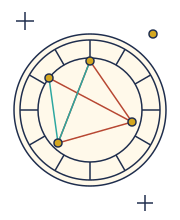
Composite Sun in the fourth house favours strong emotional involvement. Robert Hand describes a pair likely to seek out everything they have in common: past experience, shared tastes, standards of right and wrong, and above all shared ideas about home and domestic life.
The fourth is the house of the most personal and intimate life. Home, past, origins in general, and the inner feelings that go with them. The Sun there makes those the things the relationship concentrates on.
What This Placement Describes
Hand's general account of the composite fourth house widens it beyond housing. Many relationships have nothing that could be called a home and the fourth house still matters, because it indicates the roots of a relationship both literally, in geographic terms, and figuratively, in terms of mental and emotional background. It signifies the innermost depths of a connection, which may lie so far in as to be invisible at the surface.
It is the place to check for underlying compatibility. Do the two have compatible backgrounds in that sense, and are their basic emotional and psychological characteristics compatible. A strong fourth house usually indicates that two people share their innermost lives and probably share an actual address as well.
The fourth is also angular, which Hand says makes for a very strong relationship when the Sun is there.
How It Tends To Play Out
This position favours settling down together and sharing each other's personal lives as intimately as possible. Hand calls it one of the best positions for marriage. It will not by itself bring a marriage about, but should one happen, domestic life will be very important to both people. They will work hard to build a stable home and a personal world they can retire into from the pressure of ordinary existence.
There is a concrete strand to it. Hand associates the placement with a concern for owning a home or real estate together, sometimes surfacing as a wish for land. A pair living under this Sun will tend not to be satisfied with a small city apartment. They want room, and if it is possible, ground under them.
Psychologically the pair is likely to experience profound emotion together and to become deeply involved in each other's innermost mental and emotional depths. Hand says flatly that this is not likely to be a superficial relationship.
The Opposite House
The farther midpoint keeps some effect, and it strengthens as the two natal Suns approach opposition, so the fourth-house Sun is also read through the tenth. Where the natal positions are near opposition, reading both is essential in Hand's terms.
The tenth house carries the outward reality of a relationship: its status, its reputation, its direction, and the purpose it serves in the world. Hand explicitly contrasts the two. The fourth-house danger is subjectivity, and the tenth-house danger is its exact opposite, an overinvestment in externals. Reading the axis whole means asking what this inward, rooted relationship is for beyond its own walls, and whether its private depth ever gets translated into anything the outside world can see.
He supplies no threshold at which the tenth reading takes over and no procedure for merging them. The instruction is to read both houses and let both stand.
Where It Gets Difficult
The failure mode is loss of perspective. Hand's warning is to avoid becoming so wrapped up in each other's psyches that clarity goes. The fourth is a subjective house, and a composite Sun there reinforces every subjective tendency the relationship already has.
That matters because the pair is unusually good at going inward and has little pull in the other direction. Shared feeling becomes the medium of everything, including problems that would be easier to solve from a step back. The relationship can be very deep and quite unable to see itself.
There is a second, quieter risk in the emphasis on roots. A bond held together mainly by common background and a shared domestic world is strong, but it is also inward-facing, and the strength can start doing the work that active choice ought to be doing.
The house sets the issue. Whether the depth turns into insight or into fog is a matter of the aspects to the Sun, which is a separate question.
Recommended Reading
Book links below are Amazon affiliate links. As an Amazon Associate I earn from qualifying purchases, at no extra cost to you.
- Robert Hand, Planets in Composite: Analyzing Human Relationships (1975), chapter five.
- Robert Hand, Planets in Composite: Analyzing Human Relationships (1975), chapter four, on the composite fourth house and the paired house rule.
Continue Learning
Next: Composite Chart Placements and How to Read a Composite Chart.