
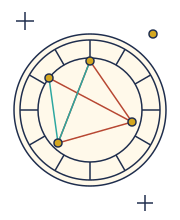
The composite Sun in the second house sets the relationship's energy on what the two people value and on what they hold. Robert Hand calls it the best possible position for any business or professional connection whose primary aim is to make money or gather material goods.
For a personal relationship he refuses to grade it. It is neither good nor bad. What it does mean is that the connection focuses rather heavily on material advantage, which can come at the expense of psychological, emotional and other intangible factors.
What This Placement Describes
The second house is the house of values, or more precisely of things that are valued, tangible or intangible. In Hand's general treatment it works on two planes at once. It shows the part value systems play in forming the relationship, meaning the extent to which two people came together because they prize similar things or ideas. It also shows whatever finances and property the relationship contains. Not every relationship has shared property, and when it does not, only the first plane applies.
The Sun there gives a strong drive to go after whatever is collectively valued. Usually that is material, though Hand allows that it can be philosophical or spiritual instead. The point he makes is about force rather than content: the pair will pursue what they want and are likely to get it, simply because they put so much energy into the effort.
He adds one structural note about composite charts generally. All finances in a composite are joint finances, because you cannot tell which person is which in the chart. The usual natal split between the second house and the eighth does not survive the technique, so both houses are worth consulting on anything financial.
How It Tends To Play Out
In a marriage or any arrangement where things are owned together, those things become genuinely important to the security of the relationship. Hand notes that a couple who would not otherwise accumulate property together may well do so under this placement. Friends with a second-house composite Sun may go into business together, or end up in a shared living situation where furniture, appliances and equipment are held in common.
Living together is a real possibility here, though Hand is careful to say it is more characteristic of a fourth-house Sun than a second-house one.
The energy signature is acquisitive in the plain sense. The relationship is oriented toward getting and keeping what it considers worth having, and it is unusually good at that.
The Opposite House
Because the farther midpoint keeps some effect, and that effect grows as the two natal positions approach opposition, a second-house Sun should also be read through the eighth house. Where the two natal Suns are near opposition, Hand treats reading both as essential.
The eighth house doubles some of this ground and departs from it in one direction. It also concerns resources and property, including the property of people outside the relationship, which is one of the few clean distinctions Hand draws between the two houses. But the eighth is chiefly the house of major transformation, the passing of an old order and the building of a new one. Read from that side, the same solar emphasis asks what the relationship is changing in each person at depth, rather than what it is accumulating.
Hand offers no threshold at which the eighth reading takes over and no formula for combining the two. He asks you to hold both.
Where It Gets Difficult
The specific danger is a conflict of values. Hand is blunt that this would be a serious problem here, precisely because the relationship rests so heavily on values in the first place. Compromise on that ground is not easy for a pair built this way.
The trap is assuming the placement guarantees agreement. It does not. A second-house Sun indicates that values are an important issue in the relationship, not that the values match. Hand's practical advice is to establish whether they are compatible before committing to any joint venture.
The second risk is one of proportion. A relationship organised around material advantage can leave the intangible side underfed, and the chart will not flag that as a problem until it becomes one.
House position shows the issue. Whether the pair handles values well or badly is read from the aspects to the Sun, which is a separate enquiry.
Recommended Reading
Book links below are Amazon affiliate links. As an Amazon Associate I earn from qualifying purchases, at no extra cost to you.
- Robert Hand, Planets in Composite: Analyzing Human Relationships (1975), chapter five.
- Robert Hand, Planets in Composite: Analyzing Human Relationships (1975), chapter four, on the composite second house and the paired house rule.
Continue Learning
Next: Composite Chart Placements and How to Read a Composite Chart.