
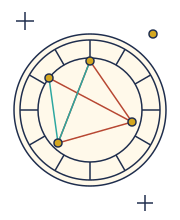
With composite Uranus in the tenth house, Robert Hand says, the purpose of the relationship may be to challenge and revolutionise the views and even the lives of the people around it. Such a relationship may revolutionise the two lives inside it as well.
He ends the delineation with a sentence that governs the whole placement: one thing is certain, this relationship must be allowed to do its own thing.
What This Placement Describes
Uranus in a composite chart is the planet of the unconventional and the unusual. Hand says it reveals alternate views of reality that let two people learn and grow, usually arriving as a surprising upset. Handling it means keeping a very open attitude and structuring life as little as possible. The house position shows where Uranus is most effective, and that area must be treated most gently, because Uranus under pressure becomes rebellious and insists on doing everything in exactly the opposite way from what is wanted.
Hand describes the tenth as the house of social status, of overall life objectives as they really are rather than as one wishes them to be, and of one's role in society. He is careful to distinguish it from the eleventh, which holds ideals and hopes, while the tenth holds the plans that will probably be realised because they are the real intention of the relationship. In a composite chart this applies to the uniqueness and evolutionary purpose of the relationship, both for the two people and for the outside world. A strong tenth house relationship is more than usually concerned with direction, and the encounter often helps the two find out what they are doing in the world.
How It Tends To Play Out
Uranus here means these areas may take an unusual direction, or that they will be a possible source of instability and disruption. Hand gives two versions of the first.
The milder one is that the two simply like to do things in their own highly individualistic style. Their public conduct is their own, and that is the whole of it. The stronger one is that their view of life is something others consider literally revolutionary. In that case the relationship is not merely unconventional in manner, it is making a claim about how things should be, and people notice.
For that stronger version he offers a specific piece of judgement. Beware of stirring up unnecessary opposition to those views. The two may feel it is important to arouse some opposition, and he does not argue with that, but he asks them to make sure that whatever they stir up is intentional.
The Opposite House
Hand's paired house rule comes from the mechanics of the composite. Any pair of planets has two midpoints. The nearer is used, but the farther keeps some effect, one that increases as the two natal positions approach opposition. So a tenth house Uranus should also be read through the fourth, and where the two natal Uranus positions are near opposition, reading both is essential.
The fourth house is the roots of the relationship, its background and innermost depths, and where there is one, the shared home. Hand's Uranus in the fourth signifies an unusual home base and, in its harder form, a home life that is unpredictable enough to give no rest. Read as an axis, the tenth is the public direction and the fourth is the private ground it stands on, and both are angular. A pair whose role in the world is unsettled will feel it at the fourth house end.
Hand gives no threshold for when the second reading takes over and no method for blending them. Both stand.
Where It Gets Difficult
Hand names one concrete hazard. Uranus in the tenth can produce sudden changes in the pair's own social status, including an abrupt and disastrous fall from grace, which he attributes to letting their activities get out of control.
That is stated as a possibility with a cause attached rather than as a fate. The instability is real, and so is the connection between it and conduct that has stopped being deliberate. His counsel about intentional opposition is the practical guard: a relationship that provokes on purpose is in a different position from one that provokes without noticing.
There is a second and quieter difficulty. The tenth house is where a relationship's real objectives live, and Uranus does not let objectives settle. A pair may find their sense of what they are for keeps moving, which is uncomfortable in a house whose business is direction.
Against all of this Hand sets the closing instruction. The relationship must be allowed to do its own thing. That is the general Uranian principle in its tenth house form: the area Uranus touches has to take its own course, with a minimum of expectations laid on it.
The house sets the issue. How the disruption is handled is described by the aspects to Uranus, which is a separate question.
Recommended Reading
Book links below are Amazon affiliate links. As an Amazon Associate I earn from qualifying purchases, at no extra cost to you.
- Robert Hand, Planets in Composite: Analyzing Human Relationships (1975), chapter twelve.
- Robert Hand, Planets in Composite: Analyzing Human Relationships (1975), chapter four, on the composite tenth house and the paired house rule.
Continue Learning
Next: Composite Chart Placements and How to Read a Composite Chart.