
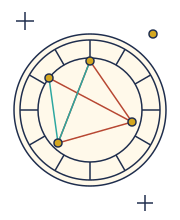
You read a Davison chart the way you read a natal chart, because that is what it is. It is cast for the midpoint in time and the midpoint in space between two births, which makes it a chart of a real moment at a real place, with real houses, real angles and real aspects. Sun, Moon, Ascendant, then Venus and Mars, then the rest. Nothing about the wheel needs special handling.
The interesting question is not how to read it but what it buys you that a composite does not, and there is a clear answer. It moves. Because the Davison is an actual moment, every predictive technique in ordinary use runs on it directly: transits, secondary progressions, solar arc directions and solar returns, with no special construction and no unresolved questions about whether the operation is legitimate.
Before the method, a boundary. Some of what follows is entailed by the construction and some of it is accumulated practice with no single authority behind it. Those are marked separately throughout, because the Davison literature is thin enough that the distinction matters.
What Is Method And What Is Practice
| Claim | Status |
|---|---|
| The chart is cast for the midpoint in time and the midpoint in space between two births | Method. It is the definition |
| Every position in it was astronomically real at that moment | Method. It follows from the construction |
| Transits, progressions, solar arcs and returns apply without modification | Method. It follows from being a real moment |
| The Sun is the relationship's core purpose, the Moon its emotional footing, the Ascendant its public face | Practice. Standard natal delineation carried across |
| The Davison shows the relationship from inside while the composite shows how it looks from outside | Practice. Widely repeated, not sourced to any controlled comparison |
| Specific Davison planet in house meanings | Practice, and largely borrowed. There is no canonical delineation set |
Why "It Can Be Progressed" Is A Real Advantage And Not A Slogan
This is worth putting precisely, because the usual version of it overstates the case against the composite.
Robert Hand says plainly that one can do almost everything with a composite chart that one can do with a conventional chart. Transits to a composite are made by the same method as to any chart, with no modification. So that half of the claim is not a difference at all.
Progressions are where the two techniques diverge. Hand's method for a progressed composite is to progress each person's natal chart separately and then cast a fresh composite of the two progressed charts. It works, in his account, and he calls the progressed composite quite a powerful tool. But he also calls the research preliminary, and it is a two stage construction rather than an ordinary operation on an existing chart.
Returns are where he is least comfortable. He has not found return charts reliable in his own work, in either zodiac, and he gives no composite return examples in the book at all. He also suspects, without concluding, that one should not do much midpoint work on a composite, because composite planets are already midpoints and you would be taking midpoints of midpoints.
A Davison chart raises none of those questions. You progress it. You cast its solar return. You direct it by solar arc. There is nothing to justify first, because it is an ordinary chart.
That, and not any claim about accuracy, is the honest case for using one.
A Working Order For Reading One
- Read both natal charts first. This is not a Davison rule, it is the rule that every serious relationship method starts with. See capacity for relationship in a birth chart.
- Sun, Moon, Ascendant. What the relationship is for, what it feels like from inside, and what it looks like from outside. These three carry most of the chart.
- The angles and anything conjunct them. A planet on the Davison Midheaven or Ascendant is the loudest thing in the chart, and the angles are also where transits land hardest.
- Venus and Mars. Affection and pursuit, warmth and conflict. Read them by house, sign and aspect.
- Saturn. What has to be built and what has to be endured. In relationship work generally, Saturn is the durability question.
- Any stellium. A house holding several planets is telling you where the relationship's attention actually goes.
- The hard aspects, last. Not because they matter least, but because reading them before you know what the chart is about turns a reading into a list of problems.
Unlike A Composite, The Signs Are Not In Question
This is a genuine practical difference and it is easy to miss.
Hand deliberately supplies no sign material for the composite chart: no rising sign, no planets in signs, no sign based house rulership. His stated reason is that the effect of signs in a composite is unknown and unsettled, and that it would be unwise to delineate a component whose effect is unknown. A footnote in the same book contradicts him, and he never resolved it.
A Davison chart has no such problem. Every planet is at a real zodiacal position at a real moment, so the signs mean what signs mean, and sign based house rulership works normally. If you want to read the chart ruler of a relationship chart, the Davison is the one that supports it without an argument attached.
Transits To A Davison Chart
The predictive layer is the reason most people cast one, so here is what that actually looks like.
Transits to the angles are where practitioners consistently report the strongest correspondence. Hand says the same thing about composite charts from his own case work, that special attention belongs on planets transiting the angles, and that the importance of such transits appears again and again across his studies. That is a composite finding rather than a Davison one, but it is about angles rather than about the construction, and it generalises cleanly.
The standard practice reads outer planet transits to the Davison Sun, Moon and angles as the structural events of a relationship, and Jupiter and Saturn transits as the annual and biennial weather. Progressed Davison Sun changing sign is treated as a shift in what the relationship is about, and the Davison solar return as a year ahead.
All of that is practice. None of it is sourced to a body of case material comparable to what exists for the composite, and a reading is more useful when it says so.
What A Davison Chart Will Not Tell You
Hand's limiting statement about the composite applies here with equal force, and it is the most useful caution in the whole relationship literature. If you cast a chart for two people who have just met, in order to find out whether the relationship will be significant, house occupancy alone cannot tell you. What a strong first house tells you is conditional: if the relationship does go beyond the initial meeting, it will be an important one.
A Davison chart describes what a relationship is like. It does not decide whether there is one.
Two more limits specific to this chart:
- The location is arbitrary. The midpoint in space is frequently open water and is usually somewhere neither person has been. The houses and angles of the chart rest entirely on that coordinate, which is worth knowing when you are weighing an angular transit.
- The moment may predate one of the people. With a wide age gap the Davison date falls before the younger partner was born.
Neither is disqualifying. Both are reasons to hold the chart a little more lightly than its clean mechanics invite.
Frequently Asked Questions
Do You Read A Davison Chart Like A Natal Chart?
Yes. It is a chart for a real moment, so signs, houses, rulers, aspects and angles all work normally. The subject is the relationship rather than a person.
Can You Put Transits On A Davison Chart?
Yes, and this is the main practical reason to cast one. Because the chart is a real moment, transits, secondary progressions, solar arc directions and solar returns all apply without any special construction.
What Is The Most Important Placement In A Davison Chart?
There is no ranked authority for the Davison the way there is for the composite. Standard practice starts with the Sun, Moon and Ascendant, then anything conjunct an angle, then Venus, Mars and Saturn.
Is The Davison Or The Composite More Accurate?
Nobody has demonstrated either. The composite has far more published interpretive material behind it. The Davison is easier to use predictively. Those are different advantages and neither settles the question.
Should I Read Both A Composite And A Davison?
You can, and if you do, record where they disagree rather than picking whichever one flatters the relationship. Adding charts until one of them says what you hoped is the failure mode this whole area of astrology is prone to.
Does The Davison Chart Have A Chart Ruler?
Yes, and this is one place it is cleaner than a composite. Signs are real in a Davison chart, so sign based house rulership works normally. Hand supplies no sign or rulership doctrine for composite charts at all.
Recommended Reading
Book links below are Amazon affiliate links. As an Amazon Associate I earn from qualifying purchases, at no extra cost to you.
- Robert Hand, Planets in Composite: Analyzing Human Relationships (Para Research, 1975), Chapter One, pp. 25 to 27, for transits to a composite by the same method as any chart, for the progressed composite method of progressing both natals and recombining them, for his scepticism about return charts and his uncertainty about midpoints of midpoints. Chapter Two, p. 31, for the deliberate absence of sign material. Chapter Three, pp. 47 to 50, for the emphasis on transits to the angles. Chapter Four, p. 72, for the limit on what a chart can predict about a relationship that has not started.
- John Townley, "Composites Vs. Davison Time Charts," astrococktail.com, for the origin and chronology of the Davison chart and for the worked midpoint location.
- Ronald C. Davison, Synastry: Understanding Human Relations Through Astrology (Weiser, 1977), the source of the technique. Not held in this library and not read for this page. Everything here described as practice rather than method comes from secondary sources.
Continue Learning
Next: What is a Davison Chart and How to Read a Composite Chart. See also Capacity for Relationship in a Birth Chart, Synastry vs. Composite vs. Davison, Progressed Synastry and How to Read a Synastry Chart.