
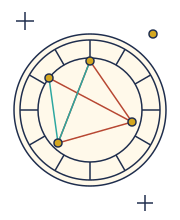
Learn one chart and four other pieces of traditional astrology stop being lists you have to memorise.
The Thema Mundi is a chart of the birth of the world. Latin for the Greek kosmou genesis, "Nativity of the Cosmos," it places every planet in one sign, with Cancer rising, and it is the single most economical object in traditional astrology. Rulership falls out of it. The natures of the aspects fall out of it. The exaltations fit it. Sect is visible in it. One arrangement, four doctrines.
And before anyone gets excited: it was used as a teaching tool. Firmicus says so directly, at Mathesis, 3, 1: 8-15, and names what it was used to explain, the rationale for the domicile rulership scheme and the qualities of the configurations, which is to say the aspects. It is not offered as a historical claim about a date on which the world began. It is a diagram.
That should make it more interesting rather than less. Somebody built a mnemonic so good that it survived two thousand years and got mistaken for cosmology.
The Positions
The original version has Cancer rising, with the Moon in the rising sign and every other planet in the sign that became its domicile.
| Planet | Sign |
|---|---|
| Moon | Cancer, also the rising sign |
| Sun | Leo |
| Mercury | Virgo |
| Venus | Libra |
| Mars | Scorpio |
| Jupiter | Sagittarius |
| Saturn | Capricorn |
The sources for these positions are Antiochus, Summary, book 2 (CCAG 8, 3, p. 119: 1-4), and Macrobius, Commentary on the Dream of Scipio, 1, 21: 23-25. Other variants are collected in Rafaelli, L'oroscopo del mundo, pp. 141-146.
The degrees are less settled than the signs, and the argument about them is a small archaeology of scribes. Firmicus puts every planet at 15 degrees of its sign, at Mathesis, 3, 1: 1, which Brennan reads as a possible later attempt to clarify something the early texts left unspecified. Paulus, at Introduction, 37, has most planets at 15 degrees but puts the Sun at 19 Aries, Mercury at 7 Virgo and Venus at 3 Libra. The Sun in Aries is odd, 19 Aries is the Sun's exaltation degree, and Paulus also says the birth of the cosmos happened in the eleventh hour of the night, which should put the Sun below the horizon rather than there. Bezza emended Paulus to put the Sun back in Leo, following a minority manuscript tradition, and Brennan says he suspects Bezza was correct. Rafaelli suggests the whole Paulus chapter may have been tampered with by Medieval scribes influenced by the Persian version of the Thema Mundi, which emphasises exaltations.
What It Explains: Domicile Rulership
In the Thema Mundi each planet sits in what became its domicile, and this appears to have been the original conceptual basis for the whole traditional rulership scheme.
The logic runs outward from the two luminaries. The Moon takes Cancer and the Sun takes Leo, the two signs on either side of the Cancer and Leo boundary. The remaining planets are then assigned in zodiacal order by their relative speed and distance from the Sun.
- Mercury never gets more than one sign away from the Sun, so it takes Virgo, one sign from Leo.
- Venus never gets more than two, so it takes Libra.
- Mars is the next furthest, so Scorpio.
- Jupiter next, so Sagittarius.
- Saturn, the furthest, slowest and dimmest, takes Capricorn, the sign opposite the Moon.
Continue the same sequence backwards from Cancer and you generate the second domicile of each planet, which is why every planet except the luminaries rules two signs. The full scheme is at domicile and planetary rulership. The point worth holding onto is that rulership is an ordering by distance from the Sun laid onto the zodiac from a single starting point, not a list of sign personalities.
What It Explains: The Qualities Of The Aspects
Ptolemy relates the natures of the configurations to the domicile assignments, and the derivation works like this.
Place every planet in its domicile. Divide the zodiac along the Cancer and Leo axis into a solar half, Leo through Capricorn, and a lunar half, Cancer through Aquarius. Then draw the aspect lines from each luminary to each planet inside its own hemisphere and see what each configuration lands on.
| Configuration | Planet it connects to | Therefore |
|---|---|---|
| Sextile | Venus | positive |
| Trine | Jupiter | positive |
| Square | Mars | difficult |
| Opposition | Saturn | difficult |
Ptolemy gives this at Tetrabiblos, 1, 18, and Firmicus discusses the same schematisation during his treatment of the Thema Mundi at Mathesis, 3, 1: 2-7. Brennan's inference is that these concepts were probably all tied together originally through the mythical birth chart.
This is the answer to the question every beginner asks and almost nobody gets answered, which is why a trine should be easier than a square. It is not a claim about geometry and it is not about degrees having moods. The trine is the distance at which a luminary meets Jupiter. The square is the distance at which it meets Mars. The aspects inherit their reputations from whoever happened to be standing there. See what are aspects in astrology for how the configurations are used in a chart.
What It Explains: The Exaltations
Superimpose the exaltation signs on the Thema Mundi and each of them configures to the rising sign, Cancer, by one of the five recognised configurations. Robert Schmidt makes this observation in Definitions and Foundations, p. 110, and the same point appears in the Persian text at CCAG 5, 2, p. 133: 18-36.
| Planet | Exaltation | Configuration to Cancer |
|---|---|---|
| Moon | Taurus | sextile |
| Mercury | Virgo | sextile |
| Sun | Aries | square |
| Saturn | Libra | square |
| Venus | Pisces | trine |
| Mars | Capricorn | opposition |
| Jupiter | Cancer | the rising sign itself |
Note what this does and does not settle, because the distinction matters. It shows that the exaltations fit the same picture. It does not explain why each planet is exalted in the sign it is exalted in, and no rationale for that survives. It is not even clear whether the exaltation signs or the exaltation degrees came first. The doctrine itself is covered at exaltation, detriment and fall.
The Joys, A Parallel Scheme And Not A Derived One
The planetary joys are often mentioned in the same breath as the Thema Mundi, and they should be kept separate. Brennan treats the joys as a parallel foundational scheme rather than something derived from the world chart, tying together the significations of the houses with sect, aspects, triplicity rulers and the exaltations.
| Planet | Joy |
|---|---|
| Mercury | 1st house |
| Moon | 3rd house |
| Venus | 5th house |
| Mars | 6th house |
| Sun | 9th house |
| Jupiter | 11th house |
| Saturn | 12th house |
The clearest citations are Paulus, Introduction, 24; Olympiodorus, Commentary, 23; Firmicus, Mathesis, 2, 15-19; and Rhetorius, Compendium, 54. Manilius is the only ancient author with a variant, putting Venus in the tenth and Saturn in the fourth at Astronomica, 2: 918-938. Houlding defended that version as genuine and Schmidt dismissed Manilius as aberrant. That one is still open.
The joys carry sect inside them. Diurnal planets have their joys above the horizon and nocturnal planets below it, with sect neutral Mercury in the first house, which in whole sign houses can fall on either side of the horizon. That arrangement is one of the reasons the sect scheme looks deliberate rather than assembled, and it connects directly to sect in astrology and to the house significations.
Sect And Gender In The Same Picture
Brennan's summary claim about the Thema Mundi is that the way it connects sign rulership, planetary gender, sect and the aspect doctrine is an example of the internal coherency of the early system.
One detail carries that. The Moon is assigned to Cancer, the first sign after the solstice, which is feminine, and the Sun to Leo, which is masculine. That may mean the masculine and feminine sign distinction was already in place when the rulership assignments were made, which in turn bears on the rejoicing conditions that later attached to sect. The day team and the night team, the benefics and malefics distributed one to each side, and the sign genders all sit inside the same diagram.
Whether a chart is a day chart or a night chart, the ranking of benefics and malefics it produces traces back through this arrangement.
Why Cancer Rises, Where The Sources Are Thin
Brennan states plainly that there is little discussion on this point in the surviving texts. No ancient explanation for the choice of rising sign has come down to us. Two pieces of lore are offered as possibly relevant rather than as doctrine, and they should be read in that spirit.
The first is from Berossus, who held that a conjunction of all the planets in Cancer meant the world would be destroyed by fire, and in Capricorn by flood. Seneca records it at Natural Questions, 3, 29: 1.
The second is Egyptian. The heliacal rising of Sirius marked the Nile flood and the start of the calendar year, occurring in July with Cancer rising just before the Sun rose in Leo. Bouche-Leclercq gives this at L'Astrologie grecque, pp. 185-6, and said it betrayed the Egyptian origin of the scheme.
Antiochus apparently called it the "nativity of god" (theou geneseos) rather than of the cosmos, at Summary, book 2 (CCAG 8, 3, p. 118: 25). Brennan reads that alongside Stoic and Hermetic pantheism as evidence the construct carried philosophical weight, which is his interpretation rather than a claim made in the astrological texts.
The Thema Mundi As A Benchmark
There is a second use, less well known than the teaching function. Antiochus, Thrasyllus and Firmicus all recommend comparing a nativity to the Thema Mundi, or to its mirror image, to see how many planets a person has in their own domiciles. Thrasyllus calls it a standard or ideal model, a kanon.
Antiochus states the reading directly: the more planets in their own domiciles a nativity has, the more brilliant, lampros, the life, and those with none experience misfortune, dustuchia. For Antiochus, CCAG 8, 3, p. 118: 29 to p. 119: 12; for Thrasyllus, CCAG 8, 3, p. 100: 27-30; and Firmicus, Mathesis, 3, 1.
That is blunt, and it reads as a measure of how much of a chart is self supplied, since a planet in its own domicile does not have to ask anyone for resources. See mutual reception for what happens when planets do have to ask, and essential dignities for the fuller assessment.
What To Actually Go Do
Draw it. Badly, on paper, by hand, once. Twelve signs, Cancer on the Ascendant, one planet per sign going clockwise from the Moon.
Then use your own drawing to answer three questions without looking anything up. Which planet does a trine reach, and which does a square reach? Why does Saturn rule two signs at opposite ends of the wheel from the lights? Where do the diurnal planets have their joys, and where do the nocturnal ones?
If the drawing answers all three, you have replaced four memorisation exercises with one picture, which is exactly what Firmicus says it was built to do.
Then go run the benchmark on your own chart and count how many planets are sitting in a sign they rule. Antiochus would like a word about the number.
Frequently Asked Questions
What Is The Thema Mundi?
It is the mythical birth chart of the world, with Cancer rising and each planet in the sign that became its domicile. Firmicus says it was used as a teaching tool to explain the rationale behind the rulership scheme and the aspect doctrine.
Is The Thema Mundi A Real Chart?
It is a teaching diagram rather than a historical claim about when the world began. Its value is that several separate doctrines can be derived from one arrangement of planets.
Why Does Cancer Rise In The Thema Mundi?
There is little discussion of the point in the surviving texts. Two pieces of lore are offered as possibly relevant: the Berossus tradition about a conjunction in Cancer destroying the world by fire, and the Egyptian heliacal rising of Sirius with Cancer rising ahead of the Sun in Leo.
What Degree Is Each Planet At?
Firmicus puts all of them at 15 degrees. Paulus has most at 15 but places the Sun at 19 Aries, Mercury at 7 Virgo and Venus at 3 Libra. Bezza emended Paulus to put the Sun back in Leo, and Brennan suspects that emendation is correct.
How Does The Thema Mundi Explain The Aspects?
Place every planet in its domicile, split the zodiac at the Cancer and Leo axis, and draw aspect lines from each luminary within its own half. The sextile lands on Venus, the trine on Jupiter, the square on Mars and the opposition on Saturn.
Are The Planetary Joys Part Of The Thema Mundi?
No. Brennan treats the joys as a parallel foundational scheme that ties the house significations to sect, aspects, triplicity rulers and exaltations, rather than as something the world chart generates.
Recommended Reading
Book links below are Amazon affiliate links. As an Amazon Associate I earn from qualifying purchases, at no extra cost to you.
- Chris Brennan, Hellenistic Astrology: The Study of Fate and Fortune (2017), for the reconstruction of the chart, the rulership derivation, the treatment of the joys as parallel, and the judgement on Bezza's emendation.
- Firmicus, Mathesis, 3, 1: 8-15, on the Thema Mundi as a teaching tool; 3, 1: 1 on the 15 degree positions; 3, 1: 2-7 on the aspect schematisation; 2, 15-19 on the joys.
- Antiochus, Summary, book 2 (CCAG 8, 3, p. 118: 25 and p. 119: 1-12), for the positions, the "nativity of god" title, and the benchmark reading.
- Macrobius, Commentary on the Dream of Scipio, 1, 21: 23-25, for the positions.
- Ptolemy, Tetrabiblos, 1, 18, for the derivation of the aspect qualities.
- Paulus, Introduction, 37, for the variant degrees; Introduction, 24, for the joys.
- Robert Schmidt, Definitions and Foundations, p. 110, for the exaltation overlay.
- Rafaelli, L'oroscopo del mundo, pp. 141-146, for the collected variants.
- Seneca, Natural Questions, 3, 29: 1, for Berossus; Bouche-Leclercq, L'Astrologie grecque, pp. 185-6, for the Sirius account.
Continue Learning
Next: domicile and planetary rulership and sect in astrology. See also exaltation, detriment and fall, triplicity rulers in astrology and how to read a birth chart.