
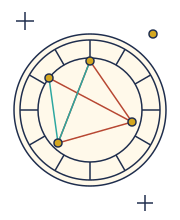
Synastry is the comparison of two birth charts to study how the planets, angles, houses and rulers in one relate to those in the other. Romantic partners, friends, family, colleagues, collaborators, clients, opponents. Anyone whose chart you can get.
It does not produce a compatibility score, and this site does not publish one. What it produces is a network:
- Which planetary functions stimulate one another;
- Which life areas each person activates for the other;
- Where interaction feels easy, demanding, attractive, stabilizing or confusing;
- How each person's natal relationship patterns enter the bond.
And before any of that, there is one rule, which two separate books state independently and almost nobody on the internet follows.
Read two complete natal charts first. Then compare them.
Arroyo opens his synastry outline with it, and his reason is flat: a person may be compatible with nobody, and no comparison means anything until you know that. Steven and Jodie Forrest arrive at the same rule on their own in Skymates, saying the work starts with a long hard look at the two birth charts, separately.
Our gloss, and it is ours rather than theirs: what a chart shows in that situation is a capacity under real constraint at a particular time, not a permanent sentence on a person. Constraint is something people work with. But it belongs to one chart, and no amount of gorgeous Venus contact with somebody else will tell you it is there. A relationship cannot be understood from one Venus and Mars aspect isolated from both lives.
What Information Does A Synastry Chart Need
For a complete comparison, use each person's:
- Birth date;
- Exact birth time;
- Birth location.
The date supplies the planetary positions. Time and location establish the Ascendant, Midheaven, houses and angles.
If a birth time is unknown, interplanetary aspects may still be useful, although the Moon can move substantially during one day. Do not rely on house overlays, angles or chart rulers without a trustworthy time. See astrology without a birth time.
Data quality should be visible in the reading. "Unknown time" is not a small footnote when a compatibility claim depends on one person's planet landing in the other's seventh house.
What Does Synastry Compare
A synastry chart is usually displayed as a bi-wheel. One natal chart sits inside, and the other person's planets ring it.
Astrologers typically compare:
- The condition of each natal chart;
- Aspects between the two charts;
- One person's planets in the other person's houses;
- Contacts with the Ascendant, Descendant, Midheaven and IC;
- Connections between house rulers;
- The Sun, Moon, Mercury, Venus, Mars, Jupiter and Saturn;
- Outer planets, lunar nodes and other points if the school uses them;
- Timing affecting either chart and the relationship.
The order matters. Outer planet and nodal contacts are extremely easy to dramatize. They should not drown out the personal planets, angles, houses, and each person's natal capacity for relationship.
First, Read Each Natal Chart
Everyone brings an existing chart into a relationship. Nobody arrives blank.
Before comparing two people, examine in each chart:
- The Ascendant and chart ruler;
- The Moon and its needs;
- Venus and patterns of attraction, pleasure and agreement;
- Mars and patterns of pursuit, conflict, desire and separation;
- Mercury and communication;
- The fifth house of pleasure, romance and sexuality;
- The seventh house of partners, contracts and open opponents;
- The eighth house of shared resources, debt, dependency and vulnerability;
- The fourth house of home and foundations;
- Rulers and aspects connecting those houses.
Worked example. If one person's natal Venus is tightly square Saturn, themes involving affection, boundaries, scarcity, duty and caution are already in the room before a second chart arrives. That placement is managing something real, usually about what affection is allowed to cost. A partner's planets may activate the pattern. They did not manufacture it out of nothing, and they cannot be held responsible for it.
Traditional relationship judgment historically gave substantial weight to each natal chart's seventh house, its ruler, relevant planets, lots and timing. Modern synastry expands the practice through systematic inter-chart aspects and house overlays. The two can work together, as long as their origins and rules stay visible. Full treatment in capacity for relationship in a birth chart.
The Most Important Planets In Synastry
Every planet matters. Different planets answer different questions.
| Planet | Relationship functions |
|---|---|
| Sun | Recognition, vitality, direction, visibility |
| Moon | Safety, care, habit, family, bodily rhythm |
| Mercury | Speech, listening, decisions, interpretation |
| Venus | Attraction, affection, pleasure, values, agreement |
| Mars | Desire, pursuit, conflict, heat, boundaries |
| Jupiter | Encouragement, growth, generosity, belief, excess |
| Saturn | Commitment, duty, structure, fear, duration, limits |
| Uranus | Excitement, change, distance, disruption, freedom |
| Neptune | Ideals, empathy, fantasy, confusion, porous boundaries |
| Pluto | Intensity, compulsion, power, exposure, elimination |
Outer planets move slowly, so many people born in the same period share similar placements. Their synastry becomes personally distinctive only when they closely contact the other person's Sun, Moon, personal planets, angles or rulers.
The Major Synastry Aspects
Inter-chart aspects show how one person's planet connects with another's.
Conjunctions
Conjunctions combine and intensify. The planets operate in the same zodiacal region and can be difficult to separate.
Moon conjunct Venus may support affection, comfort and shared pleasure. Mars conjunct Saturn can produce disciplined teamwork, frustrating restraint, durable effort, or recurring conflict between action and limitation.
Sextiles
Sextiles suggest available cooperation or exchange. Usually easier to use than squares, and they may require someone to actually pick them up.
Mercury sextile Jupiter can support teaching, humor, wide-ranging conversation and shared ideas.
Squares
Squares create friction and force engagement. They can produce conflict, chemistry, motivation, or skill developed through repeated negotiation.
Venus square Mars may create attraction alongside differing styles of desire. Mercury square Mercury can make communication stimulating while requiring translation between incompatible habits of thought.
Trines
Trines reinforce and flow. They can describe familiarity, support and ease. Ease can also preserve complacency and avoidance.
Moon trine Saturn may support dependable care and emotional containment. It can also make a restrained pattern feel so normal that neither person thinks to question it.
Oppositions
Oppositions create encounter across a polarity. Fascination, projection, complementarity, standoff, or awareness gained through the other person.
Sun opposite Moon can create a strong sense of recognition across different needs. Whether that becomes balancing or exhausting depends on the signs, houses, natal conditions and other aspects.
Charles E. O. Carter's central warning applies here with force: no aspect has one universal outcome. The planets, signs, houses, concurrent contacts and lives involved all change how it comes out.
Common Synastry Contacts And What They Can Describe
| Contact | Possible themes |
|---|---|
| Sun-Moon | Recognition between purpose and needs; life-direction and care |
| Moon-Moon | Emotional rhythm, domestic habit, mutual regulation |
| Mercury-Mercury | Communication style, interpretation, decision-making |
| Venus-Mars | Attraction, pursuit, pleasure, sexual or creative charge |
| Venus-Saturn | Commitment, loyalty, inhibition, duty, scarcity, endurance |
| Moon-Saturn | Reliability, containment, responsibility, fear, emotional distance |
| Jupiter-personal planet | Encouragement, generosity, growth, indulgence |
| Saturn-personal planet | Structure, duration, pressure, responsibility, limitation |
| Uranus-personal planet | Excitement, awakening, instability, need for space |
| Neptune-personal planet | Empathy, inspiration, idealization, ambiguity, projection |
| Pluto-personal planet | Intensity, compulsion, power negotiation, deep exposure |
That table lists possibilities, not verdicts. Venus and Saturn does not guarantee permanence. Uranus does not guarantee a breakup. Neptune does not prove deception. Pluto does not establish a "fated" bond.
What Are House Overlays
A house overlay happens when one person's planet falls in a house of the other person's chart.
If A's Venus falls in B's fifth house, A may stimulate B's pleasure, creativity, romance, play, or topics involving children. If A's Saturn falls in B's fourth, A may bring structure, responsibility, inhibition or durability to B's home and family life.
Both people are in the relationship, but the house belongs to the person receiving the overlay. Reverse the wheel and the whole map changes.
Relationship-relevant Overlays
- 1st house: identity, body, immediate recognition
- 4th house: home, family, privacy, foundations
- 5th house: pleasure, dating, creativity, sex, children
- 7th house: partnership, contracts, significant others, conflict
- 8th house: shared assets, debt, dependency, vulnerability, mortality
- 10th house: career, public role, reputation
- 11th house: friendship, alliance, shared hopes, community
- 12th house: retreat, institutions, hidden matters, isolation
No overlay should be read without the planet's natal condition. Nobody leaves their natal Mars at home when it walks into somebody else's seventh house. Full treatment in synastry house overlays.
Angles And Chart Rulers In Synastry
Contacts to the Ascendant, Descendant, Midheaven and IC tend to be conspicuous, because the angles localize a chart to one specific time and place.
- A planet on the Ascendant can feel immediate, bodily, identity-shaping.
- A planet on the Descendant may be met strongly through partnership or opposition.
- A planet on the Midheaven can affect public direction, career, visibility.
- A planet on the IC can affect home, privacy, ancestry, emotional foundations.
Chart-ruler contacts connect the planets managing each person's first house. Seventh-house rulers show how partnership topics connect between the charts. Rulership can make an otherwise ordinary aspect suddenly relevant to the relationship question.
Example: one person's Venus trine the other's Saturn matters much more if Venus rules the first house in one chart and Saturn rules the seventh in the other. Now the aspect is linking identity and partnership offices, not just Venusian affection with Saturnian duty.
Are Venus And Mars Aspects Enough For Compatibility
No. Venus and Mars contacts can describe attraction, desire, creativity or friction. Attraction is not the entire relationship, and it is the part that requires the least of anyone.
A workable bond also involves:
- Emotional regulation and daily life;
- Communication and repair;
- Compatible or negotiable values;
- Money and shared obligations;
- Boundaries and autonomy;
- Home and future direction;
- Willingness and behavior.
One exciting aspect does not automatically compensate for contempt, coercion, unreliability or incompatible goals. And a peaceful synastry chart cannot make two people choose each other.
What Are Composite And Davison Charts
Synastry compares two natal charts directly. Composite and Davison charts build a third chart to represent the relationship itself.
Midpoint Composite Chart
A composite calculates the midpoint between each pair of matching natal factors. The midpoint of the two Suns becomes the composite Sun, the midpoint of the two Moons becomes the composite Moon, and so on down.
It is a symbolic chart. It does not correspond to any literal moment of sky.
Davison Relationship Chart
A Davison is calculated from the midpoint in time and geographic space between the two births. It corresponds to a real date, time and place, although that moment is mathematically derived rather than an observed relationship event.
Neither method replaces synastry. Synastry asks how two people affect one another. A relationship chart asks how the bond behaves as a system. See synastry vs composite vs Davison.
Does Synastry Show Whether A Relationship Will Last
No single placement proves duration. Saturn contacts are often associated with commitment and endurance, and they can also describe fear, duty, inhibition, or staying attached to a burdensome structure. Uranus can describe freedom inside a long relationship as easily as sudden separation.
Duration also depends on timing. Astrologers may examine:
- Transits to either natal chart;
- Transits to relationship rulers and angles;
- Annual profections;
- Solar returns;
- Progressions and solar arcs;
- Transits to a composite or Davison chart;
- The chart of a marriage or formal beginning.
Robert Hand's work on transits supports a cautious approach here: major change is more persuasive when several independent factors reinforce each other. One Saturn or Pluto transit is not a breakup prediction, and turning it into one is a choice somebody made about you.
Synastry Is Not Only Romantic
The same method can study:
- Parent and child dynamics;
- Siblings;
- Close friendship;
- Teacher and student relationships;
- Business partnerships;
- Therapist and client dynamics;
- Creative collaboration;
- Political alliances and rivalries.
The question changes which houses and planets get priority. Mercury and tenth-house connections may matter more in an editorial partnership. Moon and fourth-house overlays may be more central in family life.
Common Synastry Mistakes
Comparing Signs Instead Of Charts
"Leo and Scorpio are incompatible" ignores the Moon, Ascendant, planets, houses, rulers and aspects in both charts. Which is to say, it ignores both charts.
Reading Only Attraction
Venus and Mars or Pluto contacts can describe charge with no communication, safety, shared values or durability attached.
Ignoring Natal Condition
An inter-chart aspect activates two natal planets that already have histories and responsibilities.
Treating Hard Aspects As Doomed
Squares and oppositions create conflict, and they also produce engagement, action and skill. Trines support ease, and they can also maintain avoidance. Neither one is the better aspect.
Declaring "Karmic," "Twin Flame" Or "Soulmate" From One Contact
Nodes, Saturn, Pluto, Vertex contacts and twelfth-house overlays attract fated language like nothing else in astrology. None of them objectively proves a metaphysical relationship category.
Predicting Abuse Or Safety From A Chart
Synastry cannot certify that a person is safe, cannot diagnose abuse, and cannot substitute for attention to observable conduct. Threats, coercion, stalking, control and violence are behavior. They get evaluated as behavior, and they do not become less serious for having an interesting chart.
Using An Uncertain Birth Time As Though It Were Exact
House overlays and angle contacts stop being reliable the moment the time is unknown.
How To Read Synastry Step By Step
- Verify both birth times and calculation settings.
- Read each natal chart independently.
- Identify each chart ruler and the relationship-house rulers.
- Compare the Sun, Moon, Mercury, Venus, Mars, Jupiter and Saturn.
- Prioritize tight inter-chart aspects.
- Check angle contacts and house overlays.
- Add outer planets and nodes when they contact personal factors closely.
- Look for repeated themes across aspects, overlays and rulers.
- Separate attraction, emotional regulation, communication, resources and duration into different questions.
- Add timing only after the natal and synastry structure is clear.
The whole grid is the relationship. One contact is a spark. Step by step version in how to read a synastry chart.
What To Actually Go Do
Do not open a bi-wheel yet. Open one chart, and make it yours.
Find these five things and write a sentence on each: the Ascendant and its ruler, the Moon, Venus by sign and aspect, Mars, and the seventh house with its ruler. That is your capacity for relationship in the sense Arroyo means it, and it exists whether or not there is currently a second chart anywhere near it.
Then do the same for the other person, before you look at a single contact between the two.
The reason for the order is practical. Once you have seen the bi-wheel, every natal pattern you find afterwards will look like it belongs to the relationship, and some of them do not. Read them in the order that keeps them separable.
Frequently Asked Questions
What Is The Best Synastry Aspect For Love?
There is no single best one. Sun and Moon, Moon and Moon, Venus and Mars, Venus and Jupiter, Mercury contacts and supportive Saturn aspects each contribute something different. A relationship needs more than one function running.
What Is The Strongest Synastry Aspect?
Tight conjunctions, oppositions and squares to personal planets or angles tend to be the most noticeable. Noticeable is not the same as beneficial. Rulership, natal condition, exactness and repetition determine importance. See the best and worst synastry aspects.
Can Synastry Show A Soulmate?
It can describe recognition, attraction, attachment, ease and challenge. It cannot objectively prove a soulmate or twin flame category, and nothing else can either.
Do Both People Feel A Synastry Aspect?
Both participate, and they may experience it very differently. The planet person expresses a function. The house person experiences that function landing in an area of life. Natal condition and self-awareness differ too.
Is A Composite Chart More Important Than Synastry?
No. They answer different questions. Synastry compares two people. A composite or Davison models the relationship as a third system.
Astrology Sources And Further Reading
- Stephen Arroyo, Relationships & Life Cycles, "Systematic Outline of Synastry," for reading the individual charts before any comparison.
- Steven and Jodie Forrest, Skymates, arriving at the same rule independently.
- Charles E. O. Carter, The Astrological Aspects, for context-sensitive interpretation of planetary relationships.
- Stephen Arroyo, Chart Interpretation Handbook, for modern chart synthesis, planets, houses and aspects.
- Steven Forrest, The Inner Sky, for a modern developmental approach to planetary symbolism and choice.
- Chris Brennan, Hellenistic Astrology (2017), chapters on houses, configurations and rulers.
- Robert Hand, Planets in Transit (1976), for timing and the need for reinforcing factors.