
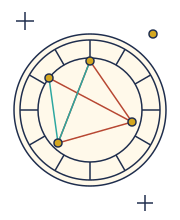
A composite chart is built from the midpoints of two birth charts, so it has planets and houses like any other chart, and those planets fall in those houses. The 120 pages linked below cover every one of those combinations, ten planets through twelve houses.
They are written from one source. Robert Hand's Planets in Composite: Analyzing Human Relationships was published by Para Research in 1975 and remains the fullest single body of composite delineation in print. Hand gives every planet in every house, and he gives a separate general essay on each of the twelve composite houses in his chapter on houses. Each page here carries both, his delineation of the planet in that house and his account of what that house means in a relationship chart, so the reading has a floor under it rather than sitting on a single paragraph.
What A Composite Placement Actually Tells You
The first thing to hold onto is what kind of object a composite chart is. It describes the relationship, not either person in it. Hand is explicit that the two people cannot be told apart inside a composite chart, which is why he treats all finances in it as joint finances and why he never assigns a planet to one partner. Where a delineation describes a pattern with two sides, such as one person rescuing and the other being rescued, the chart says the pattern is present. It cannot say who is standing where. Any reading that turns a composite placement into one partner doing something to the other has left the technique behind.
The second thing is the division of labour between houses and aspects, which Hand keeps consistently and which these pages keep with him. The house a planet occupies sets the issue. The aspects to that planet describe the handling. He says this most plainly about Pluto, where the house position indicates which area of the relationship is most likely to produce power conflict, transformation and crisis, while the aspects indicate whether that energy will be experienced as difficult or easy and what else it is tied to. The same split runs through the rest of the book. So a placement page tells you where a question lives in a relationship. It does not tell you how smoothly the two people will handle it, and it is not meant to. That is a separate reading, and it is worth doing separately.
Why Every Page Has An Opposite House Section
The paired house rule is Hand's, and it comes out of the mechanics of casting the chart rather than from any symbolic argument. Any two planets have two midpoints, exactly opposite each other. The nearer midpoint, the one on the shorter of the two arcs, is the stronger and is the one used for the composite chart. But the farther midpoint still has some effect, and that effect increases as the shorter and longer arcs approach one hundred and eighty degrees, which is to say as the two natal positions approach opposition.
His instruction follows. When reading any composite planet in a house, it is a good idea to read it in terms of the opposite house as well, and where the two natal positions are near opposition it is essential. He connects it to what astrologers already call polarity, notes that every house reflects the opposite house to some extent in any chart, and says it matters more in a composite. His summary sentence is the memorable one: it is almost as if there were six paired houses in the composite chart rather than twelve separate ones, but since one house in each pair is stronger, the traditional twelve are kept.
That is why every placement page here carries a section on the opposite house. It is not decoration and it is not a modern addition. What Hand does not give is a threshold, a percentage, or a method for blending the two readings into one. He says to read both and leaves it there, so these pages say that plainly rather than inventing a rule he did not write.
Houses, Not Signs, And Hand's Own Hesitation
There is a gap in this book that is worth naming rather than papering over. Hand supplies no composite sign delineations at all. There is no rising sign material, no planets in signs, and no use of the signs to establish house rulerships. He states that this is not an oversight.
His body text on page thirty one gives the reasoning. Earlier astrologers using the technique have felt that in a composite the signs are not real signs and the zodiac is only there to measure positions, though he reports that view rather than asserting it. His own position is that the matter has not really been settled, that the signs may have the same importance in composites that they have elsewhere, and that neither his own experience nor anyone else's has produced a firm conclusion. He leaves it to the reader to decide from their own experience. The operative editorial reason he gives for omitting them is that it would be unwise to give delineations of a chart component whose effect on the reading is unknown. He closes the section by repeating that he does not yet have a firm opinion.
A footnote on the same page says something materially different. It reports that recent experience suggests the sign on the Ascendant and the signs containing the Sun and the Moon are important, that they have exactly the influence one would expect, and that the use of the signs in a composite chart seems to be identical to their use in a natal chart. Both statements sit on the same page. Hand never retracted the body text and never supplied the delineations, and the footnote endorses three positions rather than the whole chart. Nothing here resolves that, and these pages do not pretend to. What can be said is that a house based composite reading is the one Hand actually wrote and stands behind, and that is what is on offer below.
The same restraint shows up again with the Moon's Nodes. Hand treats the composite nodes by aspect only, eleven aspect sections and no house material whatsoever, and he gives his reason directly. The effects of the nodes in the houses are not very clear as yet, anything said would be quite hypothetical, and so no delineations are given, although that might change in a future edition. It never did. Two omissions, both explained, both on the same principle: he declines to publish delineations for a factor whose effect he cannot yet describe. It is a useful thing to know about the author of the material you are reading.
The 120 Placements
Each planet runs from the first house to the twelfth. If you are new to this and want somewhere to start, Hand treats the houses of the composite Sun and Moon as the two most important positions in the chart, so those two lists are the ones to read first.
Composite Sun Through The Houses
The Sun's house is one of the two Hand treats as most important in a composite chart. It shows where the relationship's energy is concentrated and what it is fundamentally about.
- Composite Sun in the First House
- Composite Sun in the Second House
- Composite Sun in the Third House
- Composite Sun in the Fourth House
- Composite Sun in the Fifth House
- Composite Sun in the Sixth House
- Composite Sun in the Seventh House
- Composite Sun in the Eighth House
- Composite Sun in the Ninth House
- Composite Sun in the Tenth House
- Composite Sun in the Eleventh House
- Composite Sun in the Twelfth House
Composite Moon Through The Houses
The Moon's house is the other of the two Hand weighs most heavily. It carries the emotional tone of the relationship and the terms on which the two people feel at ease.
- Composite Moon in the First House
- Composite Moon in the Second House
- Composite Moon in the Third House
- Composite Moon in the Fourth House
- Composite Moon in the Fifth House
- Composite Moon in the Sixth House
- Composite Moon in the Seventh House
- Composite Moon in the Eighth House
- Composite Moon in the Ninth House
- Composite Moon in the Tenth House
- Composite Moon in the Eleventh House
- Composite Moon in the Twelfth House
Composite Mercury Through The Houses
Mercury shows where the relationship thinks and talks, and which part of life it turns into conversation.
- Composite Mercury in the First House
- Composite Mercury in the Second House
- Composite Mercury in the Third House
- Composite Mercury in the Fourth House
- Composite Mercury in the Fifth House
- Composite Mercury in the Sixth House
- Composite Mercury in the Seventh House
- Composite Mercury in the Eighth House
- Composite Mercury in the Ninth House
- Composite Mercury in the Tenth House
- Composite Mercury in the Eleventh House
- Composite Mercury in the Twelfth House
Composite Venus Through The Houses
Venus shows where affection, pleasure and the sense of what is agreeable settle in the relationship.
- Composite Venus in the First House
- Composite Venus in the Second House
- Composite Venus in the Third House
- Composite Venus in the Fourth House
- Composite Venus in the Fifth House
- Composite Venus in the Sixth House
- Composite Venus in the Seventh House
- Composite Venus in the Eighth House
- Composite Venus in the Ninth House
- Composite Venus in the Tenth House
- Composite Venus in the Eleventh House
- Composite Venus in the Twelfth House
Composite Mars Through The Houses
Mars shows where the relationship acts, pushes and generates friction, and where its energy is available to be spent.
- Composite Mars in the First House
- Composite Mars in the Second House
- Composite Mars in the Third House
- Composite Mars in the Fourth House
- Composite Mars in the Fifth House
- Composite Mars in the Sixth House
- Composite Mars in the Seventh House
- Composite Mars in the Eighth House
- Composite Mars in the Ninth House
- Composite Mars in the Tenth House
- Composite Mars in the Eleventh House
- Composite Mars in the Twelfth House
Composite Jupiter Through The Houses
Jupiter shows where the relationship expands, where it is generous and where it can overreach.
- Composite Jupiter in the First House
- Composite Jupiter in the Second House
- Composite Jupiter in the Third House
- Composite Jupiter in the Fourth House
- Composite Jupiter in the Fifth House
- Composite Jupiter in the Sixth House
- Composite Jupiter in the Seventh House
- Composite Jupiter in the Eighth House
- Composite Jupiter in the Ninth House
- Composite Jupiter in the Tenth House
- Composite Jupiter in the Eleventh House
- Composite Jupiter in the Twelfth House
Composite Saturn Through The Houses
Saturn shows where the relationship is asked for structure, patience and commitment, and where it feels the weight of that.
- Composite Saturn in the First House
- Composite Saturn in the Second House
- Composite Saturn in the Third House
- Composite Saturn in the Fourth House
- Composite Saturn in the Fifth House
- Composite Saturn in the Sixth House
- Composite Saturn in the Seventh House
- Composite Saturn in the Eighth House
- Composite Saturn in the Ninth House
- Composite Saturn in the Tenth House
- Composite Saturn in the Eleventh House
- Composite Saturn in the Twelfth House
Composite Uranus Through The Houses
Uranus shows where the relationship needs to be left free, and where it is most likely to be disrupted if it is not.
- Composite Uranus in the First House
- Composite Uranus in the Second House
- Composite Uranus in the Third House
- Composite Uranus in the Fourth House
- Composite Uranus in the Fifth House
- Composite Uranus in the Sixth House
- Composite Uranus in the Seventh House
- Composite Uranus in the Eighth House
- Composite Uranus in the Ninth House
- Composite Uranus in the Tenth House
- Composite Uranus in the Eleventh House
- Composite Uranus in the Twelfth House
Composite Neptune Through The Houses
Neptune shows where the relationship idealises, where its boundaries dissolve and where clear seeing has to be worked for.
- Composite Neptune in the First House
- Composite Neptune in the Second House
- Composite Neptune in the Third House
- Composite Neptune in the Fourth House
- Composite Neptune in the Fifth House
- Composite Neptune in the Sixth House
- Composite Neptune in the Seventh House
- Composite Neptune in the Eighth House
- Composite Neptune in the Ninth House
- Composite Neptune in the Tenth House
- Composite Neptune in the Eleventh House
- Composite Neptune in the Twelfth House
Composite Pluto Through The Houses
Pluto shows where the relationship transforms, where power gathers and where its crises are most likely to arise.
- Composite Pluto in the First House
- Composite Pluto in the Second House
- Composite Pluto in the Third House
- Composite Pluto in the Fourth House
- Composite Pluto in the Fifth House
- Composite Pluto in the Sixth House
- Composite Pluto in the Seventh House
- Composite Pluto in the Eighth House
- Composite Pluto in the Ninth House
- Composite Pluto in the Tenth House
- Composite Pluto in the Eleventh House
- Composite Pluto in the Twelfth House
Recommended Reading
Book links below are Amazon affiliate links. As an Amazon Associate I earn from qualifying purchases, at no extra cost to you.
- Robert Hand, Planets in Composite: Analyzing Human Relationships (1975), chapters four through fourteen for the house and planet delineations.
- Robert Hand, Planets in Composite: Analyzing Human Relationships (1975), chapter two, page 31, on the signs in the composite chart, body text and footnote.
- Robert Hand, Planets in Composite: Analyzing Human Relationships (1975), chapter fifteen, on the Moon's Nodes by aspect.
Continue Learning
Next: How to Read a Composite Chart, then What Is a Composite Chart and Synastry vs Composite vs Davison.