
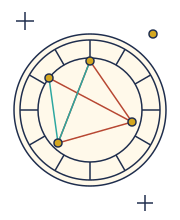
To read a synastry chart, interpret both natal charts first. Then compare personal planets, tight inter-chart aspects, angle contacts, house overlays, and the rulers of the relationship houses. Finish by finding the themes that repeat across several independent contacts.
Ten steps below. Note where the first two land. They happen before you look at the two charts together at all, which is the part almost everybody skips on the way to the fun bit.
Synastry is not a compatibility score and there is not one on this site. It is a map of how two already-complete charts interact.
Step 1: Verify Both Birth Times
Accurate times are required for the Ascendant, Midheaven, houses, chart rulers and angle contacts. If one time is unknown, use planetary aspects cautiously and drop any claim built on houses or angles.
The Moon can move roughly 12 to 15 degrees in a single day, so even Moon aspects may be uncertain. State the data limit rather than manufacturing precision that is not there. See astrology without a birth time.
Step 2: Read Each Natal Relationship Pattern
Before adding a second person, examine each chart's:
- Moon and emotional needs;
- Mercury and communication;
- Venus and affection, values and agreement;
- Mars and desire, pursuit, anger and boundaries;
- Fifth house of pleasure, romance, sex and children;
- Seventh house of partners and contracts;
- Eighth house of shared resources and dependency;
- Fourth house of home and foundations;
- Chart ruler, and the rulers of those houses.
Kevin B. Burk's Astrological Relationship Handbook starts here too, with natal needs and context before any comparison. The reason is protective. Do this first and an inter-chart contact does not get blamed for a pattern that already belonged to one person, which is the most common unfairness in a synastry reading. Fuller treatment in capacity for relationship in a birth chart.
Step 3: Compare The Sun, Moon, Mercury, Venus And Mars
Start with the personal planets, because they describe the daily functions of a relationship.
| Planet | Relationship question |
|---|---|
| Sun | Do our directions and forms of recognition work together? |
| Moon | Can our needs, rhythms and ways of caring coexist? |
| Mercury | Can we understand, explain and repair? |
| Venus | What do we enjoy, value and agree to? |
| Mars | How do we pursue, desire, compete and fight? |
Do not go hunting only for conjunctions. A trine may create ease. A square may create engagement and recurring work. An opposition may create fascination across a polarity. All three are contacts.
Step 4: Prioritize Tight Inter-chart Aspects
Read the closest major aspects first: conjunction, sextile, square, trine, opposition. Use a consistent orb policy.
A practical starting point is to prioritize contacts within three degrees, while allowing somewhat wider orbs for the Sun and Moon. That is an editorial convention, not a universal law. Declare the rule out loud before you start deciding which contacts "count," because otherwise the rule will quietly bend toward whatever conclusion you wanted.
Interpret each aspect in this order:
- What does each planet signify?
- What relationship does the aspect create?
- How do the signs modify both planets?
- Which natal houses do the planets rule?
- Is the contact repeated anywhere else?
Charles E. O. Carter's aspect work is doing the heavy lifting here: the same planetary pair can show up completely differently depending on sign, house, condition and concurrent contacts.
Step 5: Check Angle Contacts
Planets closely contacting the Ascendant, Descendant, Midheaven or IC tend to feel immediate.
- Ascendant: body, identity, approach
- Descendant: partnership, clients, opponents
- Midheaven: career, action, public visibility
- IC: home, privacy, family, roots
One person's Venus on the other's Descendant may support attraction or agreement. Saturn on the IC may bring structure, responsibility, inhibition or durability to home and family topics. The natal condition of the planet decides what it actually brings with it.
Step 6: Read House Overlays
Put A's planets into B's houses. Then reverse the wheel and do it the other way, because the answer is different.
The planet person brings a function. The house person experiences it in an area of life. Mars in another person's tenth may energize or pressure their career. The Moon in another person's fourth can activate home, family, memory and emotional foundations.
Do not call every eighth-house overlay sexual or every twelfth-house overlay karmic. The houses have concrete topics and they are more interesting than the shorthand. See synastry house overlays.
Step 7: Connect The Rulers
Rulership is what tells you why an aspect matters.
If A's chart ruler aspects B's seventh-house ruler, identity and partnership offices are directly linked. If one person's second-house ruler contacts the other's eighth-house ruler, personal and shared resources are now part of the relationship story.
This is the step that turns a list of aspects into an interpretation of these two specific charts.
Step 8: Add Jupiter And Saturn
Jupiter can bring encouragement, protection, growth, belief, opportunity or excess. Saturn can bring commitment, time, structure, fear, delay, duty or endurance.
Saturn does not guarantee permanence and Jupiter does not guarantee happiness. Ask what each one contacts, and whether the relationship benefits from the structure or the growth being offered.
Step 9: Add The Outer Planets And Nodes
Uranus, Neptune and Pluto become personally distinctive when they tightly contact personal planets or angles. The lunar nodes matter a great deal in evolutionary approaches, but a nodal contact does not objectively prove a past-life or fated relationship.
Use the outer planets to deepen a pattern you already established. Not to replace the personal planet reading, which is the actual reading.
Step 10: Synthesize By Relationship Function
Write separate conclusions for:
- Attraction and pleasure;
- Emotional safety;
- Communication and repair;
- Conflict and boundaries;
- Money and shared obligations;
- Home and daily life;
- Public or professional direction;
- Commitment and timing.
Doing it this way stops "high chemistry" from being promoted into a verdict on the entire bond. Two people can score beautifully on one of those lines and have nothing on the next three.
A Short Example
Say A's Venus conjuncts B's Mars, A's Moon trines B's Mercury, and A's Saturn squares B's Moon.
- Venus and Mars can create attraction, creative charge, and different styles of pursuit.
- Moon and Mercury can support naming feelings and understanding needs.
- Saturn and Moon can add loyalty and containment, and also fear, duty or emotional restriction.
The conclusion is not "perfect" and it is not "toxic." The comparison shows charge, communicative support, and a serious emotional task sitting inside the same relationship. Houses, rulers, natal condition, behavior and timing decide how it goes from there.
What To Actually Go Do
Take the ten steps and do only the first two this week.
Print or write out the nine items in step 2 for one chart. One line each. Then do it again for the other chart. Do not open a bi-wheel, do not look up a single inter-chart aspect, and specifically do not look up Venus and Mars.
When you finally do compare, you will already know which patterns were in the room before the two of you met, and that is the one piece of information the bi-wheel is structurally incapable of giving you. Everything in the comparison will look like it belongs to the relationship. Some of it never did.
Recommended Reading
Book links below are Amazon affiliate links. As an Amazon Associate I earn from qualifying purchases, at no extra cost to you.
- Kevin B. Burk, Astrological Relationship Handbook (Serendipity Press, 2006).
- Steven Forrest and Jodie Forrest, Skymates.
- Charles E. O. Carter, The Astrological Aspects.
- Stephen Arroyo, Relationships & Life Cycles.