
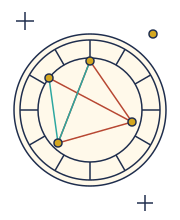
Your chart ruler is the planet that rules your rising sign. Because the rising sign establishes the first house and organizes the rest of the chart, its ruling planet becomes a primary carrier of your direction, embodiment, and approach to life.
Finding it takes two steps:
- Calculate your rising sign from an accurate birth time and place.
- Identify that sign's planetary ruler.
Then read the ruler by sign, house, aspects, and condition. Naming the planet is only the beginning.
Chart Ruler Table
| Rising sign | Traditional ruler | Common modern co-ruler |
|---|---|---|
| Aries | Mars | , |
| Taurus | Venus | , |
| Gemini | Mercury | , |
| Cancer | Moon | , |
| Leo | Sun | , |
| Virgo | Mercury | , |
| Libra | Venus | , |
| Scorpio | Mars | Pluto |
| Sagittarius | Jupiter | , |
| Capricorn | Saturn | , |
| Aquarius | Saturn | Uranus |
| Pisces | Jupiter | Neptune |
Traditional rulerships form a complete system based on the seven visible planets. Modern astrologers often add Uranus, Neptune, and Pluto as co-rulers. Using a modern co-ruler can add information, but replacing the traditional ruler can break older techniques such as essential dignity, house rulership, and time-lord systems.
Why Is The Chart Ruler Important?
In Hellenistic astrology, the domicile lord of the Ascendant was one of several planets examined when assessing life direction and support. Chris Brennan devotes a full chapter of Hellenistic Astrology to the ruler of the Ascendant. Stephen Arroyo also uses the Ascendant's ruler as a practical key to chart synthesis.
The logic is simple:
- The first house signifies the person and life.
- The rising sign sets the conditions of the first house.
- The ruler manages that sign.
- The ruler's placement connects the person to another house and set of topics.
If Cancer rises, the Moon rules the chart. A Moon in the eleventh ties the life path to friends, groups, alliances, patrons, and hopes. A Moon in the second ties it more strongly to resources, income, possessions, and security.
How To Interpret Your Chart Ruler
1. Start With The Planet
Each planet carries a basic set of functions:
- Sun: vitality, leadership, visibility, purpose
- Moon: body, needs, care, habit, change
- Mercury: speech, thought, trade, analysis
- Venus: union, pleasure, value, art, reconciliation
- Mars: action, severing, conflict, courage
- Jupiter: growth, faith, counsel, protection
- Saturn: limits, duty, time, endurance, exclusion
2. Read Its Sign
The sign shows the ruler's style and resources. Traditional astrology asks whether the planet has dignity, debility, or other support there. Psychological astrology may focus more on the mode through which the function seeks expression.
Mars ruling an Aries Ascendant behaves differently in Capricorn than in Cancer. The planet is the same actor; the sign changes its operating conditions.
3. Read Its House
The house shows where the chart ruler works. This often identifies a life area that repeatedly demands attention.
- Chart ruler in the 2nd: resources, income, livelihood
- 4th: home, parents, land, foundations
- 7th: partnership, clients, opponents
- 9th: education, travel, religion, divination
- 10th: career, reputation, public action
- 12th: retreat, institutions, hidden difficulties, isolation
These are not promises of success or failure. Planetary condition and the rest of the chart determine how the topics unfold.
4. Read Its Aspects
Aspects show the ruler's relationships with other planetary functions. A tight Saturn aspect may add responsibility, delay, discipline, or pressure. Jupiter may add opportunity, counsel, protection, or excess. Mars can accelerate or conflict; Venus can reconcile or bind.
Avoid cookbook verdicts. Charles Carter's work on aspects is especially useful here: context changes manifestation.
5. Assess Condition
Traditional assessment may include sect, sign dignity, house, angularity, speed, visibility, retrogradation, and aspects from benefics or malefics. Demetra George's Ancient Astrology in Theory and Practice offers a systematic framework for this.
Condition answers a practical question: how able is the chart ruler to do its work?
Chart Ruler Example
Suppose someone has Libra rising. Venus rules the chart.
If Venus is in Capricorn in the fourth house, the life may repeatedly organize itself around home, property, family obligations, ancestry, or private foundations. Capricorn gives Venus a Saturnian environment: commitments, structure, boundaries, and long-term construction may matter more than spontaneity.
If Venus squares Mars in the seventh, partnership can become an active arena of attraction, negotiation, conflict, and choice. That does not mean “bad relationships.” It means the chart ruler's agenda cannot be read without Mars and the seventh house.
Frequently Asked Questions
Is The Chart Ruler The Strongest Planet?
Not automatically. It is important because of its office, but another planet may be more angular, dignified, or dominant. “Most important” depends on the question.
What If My Chart Ruler Is Retrograde?
Retrogradation is one condition among many. It can describe revision, irregular pacing, reversals, or a more internalized process, but its meaning depends on the planet, house, sign, and aspects.
Can I Have Two Chart Rulers?
If you use modern co-rulerships, you may study both. For techniques built on traditional rulership, use the traditional ruler as the primary ruler and treat the outer planet as an additional testimony.
Recommended Reading
Book links below are Amazon affiliate links. As an Amazon Associate I earn from qualifying purchases, at no extra cost to you.
- Chris Brennan, Hellenistic Astrology (2017), chapter 12, “The Domicile Lord of the Ascendant.”
- Demetra George, Ancient Astrology in Theory and Practice, Volume One (2019), chapters on rulership and planetary condition.
- Stephen Arroyo, Chart Interpretation Handbook, Ascendant and chart-ruler sections.
Continue Learning
Next: How to Read a Birth Chart.