
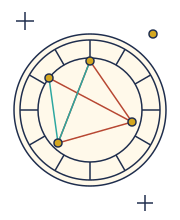
Oner Doser says Abu Ma'shar held that two planets in each other's dignities need no aspect at all. Anthony Louis quotes Abu Ma'shar's own text requiring an applying aspect, which is the strictest position anybody takes on the question.
Same medieval astrologer. Two modern authors. Opposite answers. And they do the same thing with Lilly.
That is not a footnote, because the disagreement decides whether a configuration in your chart exists at all. Under one rule you have mutual reception. Under another you have something else with a different name. Nobody in this library resolves it, and pretending otherwise would be the actual mistake.
What Everyone Does Agree On
A planet in a sign it does not rule is a guest. It is standing on someone else's property, and it has to ask the owner of that property for what it needs in order to do its job. That relationship, between a planet and the lord of the sign it occupies, is the doctrine of reception.
Mutual reception is what happens when two planets are guests in each other's houses at the same time. Sun in Sagittarius while Jupiter is in Leo. Demetra George's image for it is exact: if simple reception is being an extended guest in someone's home, mutual reception is trading homes with them. Each is much freer to use the amenities, knowing the generosity runs both ways. The two planets can pool resources and undertake things jointly that neither would manage alone.
That is the agreed part. Almost everything else is contested, and the disagreement is not decorative: three sources give three different rules for when the condition even exists.
Reception, Before Mutual Reception
Start with the one directional case, because the mutual case is built out of it.
A planet in a sign other than its own domicile is a guest on another planet's estate, and it must look to that host to supply the resources it needs. Oner Doser's short form of the same rule: reception is when a planet hosts another planet in the sign that it rules.
George's contrast with modern practice states what this changes. A modern reading of the Moon in Gemini says there is an emotional need to make mental contacts. The traditional reading says the Moon is a guest in Mercury's domicile, and Mercury supplies her with what is in the Gemini basket, words, reason, intellect and friends, with which to accomplish her agenda. The move is from describing the planet in the sign to asking who supplies it and with what.
Which produces four questions to ask about any host. Does the host have the resources to give what is being asked, which is a question about the host's own sign? Is the host generous or harsh, benefic or malefic? Is the aspect connection supportive or begrudging, sextile and trine against square and opposition? And is the host a sect mate, a friend, or a member of the opposite sect, a stranger, which is a question about sect and so about whether the chart is a day chart or a night chart?
George attaches a claim to this that is unusual in dignity doctrine, because it is directional rather than static. A planet in difficult condition with a good aspect to a well endowed domicile lord will benefit, and the good fortune increases over the lifetime. Where the domicile lord is itself in poor condition, the topics of that planet decrease and suffer over the course of a lifetime. Very few traditional rules have a slope. This one does.
Domicile, Exaltation, And Whether The Lesser Dignities Count
Reception runs on dignity, so the question of which dignities can carry it decides how often it occurs.
There is a clean split between eras. George states that the Hellenistic astrologers limited mutual reception to domicile rulership, while the Medieval texts considered mutual receptions beneficial in accordance with all the rulership systems, domicile and exaltation and some combination of triplicity, bounds and faces. That is a period difference with real consequences: a Hellenistic engine and a Medieval engine should not be running the same reception rule.
Between those two there is a third position. Louis, summarising Bonatti's Liber Astronomiae (1277, trans. Dykes 2010), reports that dignity for reception can be by domicile, exaltation, triplicity, term or face. He then gives Abu Ma'shar's ranking inside that list, at section 53: the strongest are the lord of the house and the lord of the exaltation, while the lords of term, triplicity and decan are weak unless two or more of them are joined.
| Position | Which dignities carry reception |
|---|---|
| Hellenistic, per George | Domicile only |
| Abu Ma'shar, per Louis | Domicile and exaltation strongly; term, triplicity and face only in combination |
| Medieval, per George | All rulership systems |
A mixed case is common and worth naming. Where one planet sits in the other's domicile and the second sits in the first's exaltation, the exchange is uneven, because the two planets are not offering each other the same grade of hospitality. On Abu Ma'shar's ranking both are strong dignities, so the exchange stands. On the strict Hellenistic rule it is not mutual reception at all.
The Aspect Question, Where The Sources Fight
This is the largest unresolved disagreement in traditional reception doctrine, and it comes down to one question: do the two planets have to see each other?
Position one. An aspect is required. George states that the Medieval texts specify that the two planets must have an aspect between them for the reception to be valid. In her summary she extends it to simple reception as well, making a whole sign aspect between a planet and its host necessary, and better still if the host is a sect mate. Doser attributes the same requirement to Bonatti.
Position two. No aspect is required. Doser reports that Abu Ma'shar, Ibn Ezra and William Lilly held that if two planets are in each other's dignities by domicile, exaltation or other rulerships, they do not need an aspect, and that this case is called generosity. George gives the same term to Ibn Ezra: not all astrologers agree the aspect is necessary, and Ibn Ezra calls the aspectless exchange generosity. There is still reception, but apparently not as strong.
Position three, the strictest of the three. An applying aspect is required. Louis quotes Abu Ma'shar's own text (1994, section 52) giving reception as one planet applying to another from the second planet's house, exaltation, term, triplicity or decan, so that the second receives the first. Louis then says explicitly that Abu Ma'shar requires an applying aspect, and that where no such aspect exists, the planet occupying a dignity of the other is said to be in the other's generosity. A separating aspect does not qualify.
Set side by side, the contradiction is direct and it does not resolve. Doser puts Abu Ma'shar on the no aspect needed side. Louis quotes Abu Ma'shar's own text requiring an applying aspect, which is the strictest position of any source here. Doser also puts Lilly on the no aspect side, while Louis, working from Lilly, treats an aspect as part of the definition. These cannot both be right.
There is a further wrinkle in how Louis frames the whole thing. He treats generosity and mutual reception as two separate named conditions rather than as strong and weak forms of one, and quotes Joy Usher (2018, p. 122) for the definitions: generosity is two planets in each other's sign with no aspect, and mutual reception is two planets in each other's sign who also share a Ptolemaic aspect. On that framing, the aspectless case is not weak mutual reception. It is a different thing with its own name.
| Threshold | Requirement | Authority named |
|---|---|---|
| Loosest | Sign exchange alone, no aspect | Abu Ma'shar, Ibn Ezra and Lilly, per Doser |
| Middle | Any whole sign aspect, applying or separating | The Medieval texts, per George; Bonatti, per Doser |
| Strictest | An applying aspect | Abu Ma'shar's own text, per Louis |
Pick one, and say which one you picked. If you work Hellenistic, take domicile only and the loosest threshold. If you work horary out of Lilly and Bonatti, an aspect is part of the definition and you should say so when you use the term. What you should not do is call a configuration mutual reception without naming the threshold, because a reader working to a different one hears a different claim.
The Gradations, And What Reception Actually Buys
George ranks the cases from best to most difficult, and the ranking is instructive because the worst case is not the one people expect.
- Best: mutual reception connected by a trine. Her example is the Sun in Sagittarius trine Jupiter in Leo.
- More challenging: mutual reception connected by an opposition. Her example is Jupiter in Virgo opposite Mercury in Pisces, compounded because each planet is also in its detriment. There is definite benefit and strengthening for each, but the good is limited to what each had to begin with, and there is tension in the reciprocation.
- Most difficult, on her report of the ancient astrologers: no aspect at all and both planets in detriment, her example being Venus in Aries and Mars in Taurus. The detriment of both shows scarcity, and the absence of an aspect means there is no line of communication in which to even discuss helping each other.
Read that third case again. The opposition is not the bad one. Two planets with no aspect and nothing to give is the bad one, because at least the opposition is a conversation.
As for what reception is worth once it exists, Louis gives Bonatti's ordering of configurations between significators, from easiest to hardest.
| Rank | Configuration |
|---|---|
| 1, easiest | Trine with reception |
| 2 | Trine without reception, or sextile with reception |
| 3 | Sextile without reception, or square with reception |
| 4 | Square without reception, or opposition with reception |
| 5, hardest | Opposition with no reception |
The structural claim in that table is the useful part: reception is worth roughly one step of aspect quality. A square with reception sits at the same rank as a sextile without it. Louis gives Bonatti's specific case, that a sextile without reception resembles a square with reception, indicating a moderate amount of difficulty and hardship.
Louis is careful about what the hard end of that ladder means. Not that the matter fails, but that it will require diligence and persistence and will perfect only under increasing difficulty, effort, toil, anxiety and expense. Reception governs the cost of the outcome, not the outcome. Lilly's own aphorism, quoted short, is that notwithstanding reception, an infortune performs "but slowly." Derek Appleby (1985, p. 35) adds that two planets in each other's domiciles usually leave the querent some choice in the matter, with assistance from a third party or an escape route available.
Refusal, The Counterpart Nobody Implements
Louis reports one condition the other sources do not give, and no software you own is checking for it. The Medieval astrologers called it refusal when a planet lies in a place of another planet's debility, its detriment or fall, and Louis calls this reception by debility.
His worked case: Venus in Cancer applying by sextile to Mars in Taurus. Mars is in his detriment in Taurus, which is Venus's domicile, so Venus can help Mars. But Cancer is the fall of Mars, because Mars is exalted in the opposite sign, Capricorn, so Mars refuses to help Venus, who is asking from a place he will not touch. The favourable sextile does not override it.
Check only the five positive dignities and that configuration reads as help offered in both directions. It is not. It is help going one way and a door closing the other way, and the sextile is what makes you miss it.
What To Actually Go Do
Find a mutual reception in your own chart if you have one, and then do the thing this article is actually about: write down which threshold you used.
Domicile only, or domicile plus exaltation, or all five dignities? Aspect required, no aspect required, or applying aspect required? Put the answer somewhere you will see it again, because the moment you change the threshold you change which configurations exist, and you will not remember six months from now which rule you were running.
Then, while you are in there, run the refusal check on any planet sitting in another planet's detriment or fall. That is the case nobody looks for, and the sources here give you a worked example of it flipping a reading.
Frequently Asked Questions
What Is Mutual Reception In Astrology?
Mutual reception is two planets each sitting in a sign the other rules, so that each is a guest in the other's home. The classic example is the Sun in Sagittarius with Jupiter in Leo.
Does Mutual Reception Require An Aspect?
The sources disagree. George reports the Medieval texts requiring one, Doser puts Abu Ma'shar, Ibn Ezra and Lilly on the no aspect side, and Louis quotes Abu Ma'shar's own text requiring an applying aspect. Choose a threshold and state which authority you are following.
What Is Generosity In Astrology?
Generosity is the name Ibn Ezra gives to two planets in each other's dignity with no aspect between them. Doser treats it as a weaker form of reception, while Louis, following Joy Usher, treats it as a separate condition from mutual reception rather than a lesser grade of it.
Does Reception By Exaltation Count?
On Abu Ma'shar's ranking the lord of the house and the lord of the exaltation are the two strongest dignities for reception, so it counts. The Hellenistic rule George reports limits mutual reception to domicile alone.
Do Triplicity, Bounds And Faces Carry Reception?
Abu Ma'shar's ranking calls the lords of term, triplicity and decan weak unless two or more of them are joined. The Medieval texts more broadly accepted all rulership systems. The Hellenistic tradition used domicile only.
What Does Mutual Reception Do To A Difficult Aspect?
Bonatti's ordering treats reception as worth roughly one step of aspect quality, so a square with reception ranks alongside a sextile without it. What it changes is the cost and difficulty of the outcome rather than the outcome itself.
Recommended Reading
Book links below are Amazon affiliate links. As an Amazon Associate I earn from qualifying purchases, at no extra cost to you.
- Demetra George and Chris Brennan, Ancient Astrology in Theory and Practice, for the guest and host doctrine, the four questions about the host, the lifetime trajectory rule, the gradations of mutual reception, the Medieval aspect requirement, Ibn Ezra on generosity, and the Hellenistic domicile only limit.
- Anthony Louis, Horary Astrology: The Theory and Practice of Finding Lost Objects, for Abu Ma'shar 1994, sections 52 and 53, on the applying aspect and the ranking of dignities; for Bonatti, Liber Astronomiae, 1277, trans. Dykes 2010; for the aspect and reception ladder; for refusal; for Joy Usher 2018, p. 122; for Derek Appleby 1985, p. 35; and for Lilly on the missing ship.
- Oner Doser, Financial Significators in Traditional Astrology, for the short definition of reception, mutual interaction as a synonym, and the attribution of the no aspect position to Abu Ma'shar, Ibn Ezra and Lilly.
- William Lilly, Christian Astrology, quoted by Louis on reception and on an infortune performing "but slowly," and for the missing ship judgment in which reception lets some of the seamen escape.
Continue Learning
Next: essential dignities in astrology and domicile and planetary rulership. See also exaltation, detriment and fall, sect in astrology and the Thema Mundi, where the rulership scheme reception depends on is derived.