
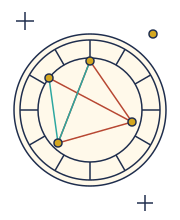
Transits are the current positions of the planets measured against a natal chart, or against any other reference chart you care to use. Astrologers read them to describe periods when a natal planet, angle or house is getting activated.
The astronomy is not in dispute. Planets kept moving after you were born, which they would have done regardless. The astrological claim starts the moment meaning gets attached to those movements and to their angular relationships with a birth chart. Worth being clear about where the observable part stops and the interpretive part begins.
How Transits Work
Every planet is sitting at a zodiacal degree right now. When a moving planet reaches a meaningful angular distance from one of your natal planets, that is a transiting aspect.
The five major aspects:
| Aspect | Approximate angle | Basic relationship |
|---|---|---|
| Conjunction | 0° | Union, concentration, new cycle |
| Sextile | 60° | Opportunity, workable exchange |
| Square | 90° | Friction, action, conflict, pressure |
| Trine | 120° | Flow, reinforcement, ease |
| Opposition | 180° | Polarity, encounter, culmination |
The aspect on its own is not an event. It is a geometric fact waiting for context. Interpretation depends on the transiting planet, the natal planet, the houses both of them rule, the houses they occupy, the natal planet's condition, your declared orb, and whatever other timing techniques are running at the same moment.
What Each Transiting Planet Tends To Describe
- Sun: visibility, focus, vitality, annual illumination
- Moon: mood, body rhythms, daily movement, immediate circumstances
- Mercury: messages, decisions, travel, trade, analysis
- Venus: relationships, values, agreements, pleasure, money
- Mars: action, conflict, heat, injury, severing, effort
- Jupiter: expansion, opportunity, belief, counsel, excess
- Saturn: limits, duties, consolidation, delay, endurance
- Uranus: disruption, release, innovation, instability
- Neptune: diffusion, imagination, idealization, confusion
- Pluto: compulsion, exposure, elimination, concentrated power
These are broad families of meaning, not predictions with the serial numbers filed off. A transit gets specific only when it lands inside a particular natal system.
Outer And Inner Planet Transits
Outer planets move slowly and create long developmental periods. Inner planets move quickly and mostly act as timers.
Robert Hand explains in Planets in Transit that a slow outer planet transit may describe the larger process while a faster planet's exact contact coincides with the visible event. He also notes that the important periods commonly contain several transits at once.
Which gives you a working hierarchy:
- Slow planet establishes the season.
- Natal rulership identifies likely topics.
- Faster planets identify shorter windows.
- Other timing methods confirm or weaken the case.
The slow planet is the weather system. The fast planet is the thing that makes you look up.
What Is An Orb
An orb is how far from exact you are willing to let an aspect count. If transiting Saturn is at 14° Pisces and your natal Mercury is at 15° Gemini, the square is one degree from exact.
Astrologers use different orbs, which is allowed. What is not allowed, or at least not honest, is picking the orb after you have seen the result. Declare your orbs before you evaluate anything. Wider orbs give you more matches and also more false positives, and both of those things happen quietly.
For predictive work, close and applying contacts deserve priority. Slow planet retrogrades can produce three exact passes over the same natal degree.
Applying Vs. Separating
An applying transit is still moving toward exactness. A separating transit has already perfected and is moving away.
Applying phases can correlate with buildup and emergence. Separating phases can correlate with consequence, processing and release. Useful interpretive distinction, not a universal event schedule, and people do stretch it further than it goes.
How To Read A Transit Step By Step
Suppose transiting Saturn squares your natal Venus.
- Name the planets. Saturn concerns limits, duty, structure, time and consequences. Venus concerns union, value, pleasure, money and agreement.
- Identify natal rulership. If Venus rules your second and ninth houses, then finances, values, education, belief or travel may be implicated.
- Locate the transit. Saturn's current house tells you which field the pressure is arriving from.
- Assess natal Venus. A well supported Venus responds differently from one already under serious strain.
- Check the stack. Is Venus activated by annual profection, solar return, progressions or solar arc?
- Write a bounded forecast. A small set of plausible topics and an actual date window.
- Score the result. Record the misses and the ambiguous ones, not just the wins.
This is meaningfully more useful than announcing "relationship problems" after the relationship problems have already happened.
Why One Transit Is Not Fate
A single aspect can point at a real theme and still pass without anything visible attaching to it. You have many concurrent transits at all times, and not every planet in your chart is equally on duty in every year.
Traditional time lord methods such as annual profections hand temporary responsibility to specific planets and houses. Charles Obert emphasises congruence for exactly this reason: transits become persuasive when the natal chart, the time lord, the solar return and the directions all point at the same topics.
What you get out of that is not a louder prediction. It is a more focused reading of which life topics are genuinely in play and over what stretch of time.
What To Actually Go Do
Pick one slow transit that is currently within two degrees of a natal planet or angle. One. Not the whole list.
Write down four things before you look anything else up: the two planets, the natal houses that planet rules, the house the transiting planet is sitting in, and the orb you have decided to use. Then write one sentence naming a plausible topic and a date window, and leave it alone.
If you want to make it properly useful, add the annual profection for your current age and see whether the natal planet being hit happens to be your lord of the year. When those two agree, you have something. When they do not, you have a mildly interesting transit and a free evening.
Frequently Asked Questions
How Long Does A Transit Last?
It depends on the planet's speed and your declared orb. Moon transits can be a matter of hours. Uranus, Neptune and Pluto can stay within range for a year or more, and often make three exact passes.
What Orb Should I Use?
Whatever you like, as long as you write it down first and keep it. The failure mode is not a wide orb, it is a flexible one.
Why Does The Same Transit Mean Different Things For Different People?
Because it lands on a different natal planet, in a different condition, ruling different houses. The transiting planet supplies the process. Your chart supplies the address.
Should I Worry About A Hard Aspect?
A square or opposition describes friction and pressure rather than a sentence. Look for the topics your natal planet already governs and ask what in that area has been running on optimism rather than structure.
Recommended Reading
Book links below are Amazon affiliate links. As an Amazon Associate I earn from qualifying purchases, at no extra cost to you.
- Robert Hand, Planets in Transit: Life Cycles for Living (1976), especially "Interpreting Transits" and "Timing Transits."
- Charles Obert, The Cycle of the Year (2018), chapters on profections, solar returns, directions, and transits.
- Chris Brennan, Hellenistic Astrology (2017), chapter 17 on annual profections and activated transits.
- Charles E. O. Carter, The Astrological Aspects, for context-sensitive aspect interpretation.
Continue Learning
Next: natal chart vs. transit chart for how the two charts sit against each other, and annual profections for the year filter.