
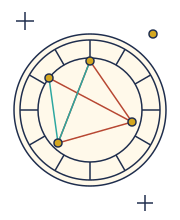
Taurus is often described as slow, although that word leaves out the reason for the pace. Taurus wants enough contact with an experience to know whether it is comfortable, useful, sustainable or worth keeping, and those questions are difficult to answer from a sprint. It trusts what can be observed, handled and repeated, which is why a Taurus placement may take its time at the beginning, then become extraordinarily difficult to move once it has settled on an answer.
The planet tells us where this process occurs. Taurus rising approaches life methodically, while a Taurus Sun builds identity around stability, competence and the ability to produce something real. A Taurus Moon settles through familiarity and physical comfort, Mercury in Taurus wants an idea it can hold onto, Venus in Taurus develops attachment through the senses, and Mars in Taurus conserves its effort until there is a reason to spend it.
These placements may share patience, consistency and a strong relationship with the material world, but they are not six versions of the same personality. Taurus changes the way each planetary function operates, and the rest of the chart determines whether its steadiness becomes a resource, a refusal or, as is often the case, some inconvenient combination of both.
Taurus At A Glance
| Factor | Taurus |
|---|---|
| Element | Earth |
| Modality | Fixed |
| Polarity | Feminine or nocturnal |
| Ruler | Venus |
| Exaltation | The Moon |
| Opposite sign | Scorpio |
| Symbol | The Bull |
| Season | The middle of spring in the Northern Hemisphere |
Earth signs work through physical reality, practical judgment and the evidence of the senses, while fixed signs concentrate energy and preserve what has already taken form. Venus, the ruler of Taurus, adds value, pleasure, attraction and the wish to cultivate what feels good enough to keep. Together, these qualities describe a sign that is less interested in possibility for its own sake than in what can be made reliable.
Traditional astrology considers Venus at home in Taurus and the Moon exalted there, while Mars has a more difficult relationship with the sign. These conditions describe how readily a planet can carry out its own work, although the entire chart still matters. A Taurus Venus is not automatically happy, and a Taurus Mars is not automatically ineffective; each placement has a particular set of resources and complications to manage. The fuller framework is in essential dignities in astrology.
How Taurus Energy Works
Taurus consolidates, so where Aries creates movement, Taurus decides what deserves to remain, then gives it enough time, attention and material support to become stable. This may involve money or property, but it can just as easily involve a skill, relationship, daily practice, garden, recipe or chair that has survived three moves because replacing it would be ridiculous when that one is perfectly good.
The sign has a close relationship with the senses, which provide information before an explanation is available. Taurus notices texture, tone, temperature, appetite, physical tension and whether a space actually feels pleasant to inhabit. Its choices may appear stubbornly subjective to someone working from theory, although Taurus often has a practical reason that becomes obvious once everybody has to live with the result.
Fixed earth is patient because it does not want to waste effort. Taurus would rather find a workable pace and maintain it than repeatedly exhaust itself through dramatic starts and stops, which can make the sign dependable over long periods. The same instinct becomes limiting when conservation continues after the situation has stopped being good, since familiarity can feel safer than an improvement that has not yet been tested.
Pleasure is part of the sign's intelligence, not a decorative extra. Taurus can recognize what nourishes, restores and makes continued effort possible, although comfort occasionally becomes so persuasive that the next step loses its appeal. The difficulty is not always fear of failure; sometimes the current arrangement is simply comfortable enough to postpone the work indefinitely.
Taurus Rising
The rising sign describes how a person enters situations and engages with the immediate world, and Taurus rising usually prefers to begin with observation. These people often appear calm, measured or self-contained, particularly when others are moving faster than the situation requires. They may take longer to respond, not because nothing is happening, but because they are checking the response before they commit themselves to it.
There is often a strong awareness of pace. Taurus rising dislikes being rushed into decisions, spaces, relationships or schedules that the body has not agreed to, and pressure can make the person slower rather than faster. Once comfortable, however, the same person may become steadily productive, since the rising sign is less interested in bursts of effort than in establishing a rhythm it can continue.
Because Taurus is rising, Venus becomes the chart ruler, so its sign, house and aspects substantially change the presentation. Venus in Gemini may make Taurus rising more verbally agile and curious, Venus in Capricorn can emphasize restraint and long-range ambition, while Venus in Pisces may make the approach softer, more imaginative or emotionally receptive. The Taurus pace remains, but Venus tells us what the person values enough to move toward.
The early environment matters as well. Someone whose steadiness was trusted may develop visible calm and confidence, while someone repeatedly pushed beyond a comfortable pace may use control as a form of self-protection. Read what is a chart ruler to follow Venus through the rest of the chart.
The Sun In Taurus
The Sun describes identity, purpose and the experience of being fully oneself, and in Taurus, that identity grows through continuity. A Taurus Sun usually wants to know that its effort has substance, whether that means producing excellent work, building financial security, caring for the same people over time or developing a skill until it becomes second nature.
Reliability can become a source of pride, especially when the person is known for doing what they said they would do. There is often satisfaction in tangible evidence, since an idea feels more meaningful once it has become a finished object, a paid bill, a well-run home or a result that can be measured. Recognition tends to matter most when it confirms real competence rather than offering praise with no weight behind it.
The difficulty appears when identity becomes attached to consistency itself. Changing course may feel like admitting the earlier choice was wrong, even when the earlier choice was perfectly reasonable at the time. Taurus Suns become more flexible when change is understood as preservation of what truly matters, rather than destruction of everything they have already built.
The Moon In Taurus
The Moon describes emotional needs, familiar reactions and the ways we restore a sense of safety, and in Taurus, safety is closely connected with steadiness. The nervous system often responds well to predictable routines, familiar surroundings, nature, food, sleep, touch and enough time to let a feeling settle before anybody demands an explanation.
This Moon can remain composed when the outer environment becomes chaotic, partly because it does not change emotional direction with every passing influence. That steadiness is one reason traditional astrology considers the Moon exalted in Taurus, since the fluctuating Moon receives containment from fixed earth without losing its capacity to nourish.
Attachment runs deep, however, and the Moon may continue holding a habit, object, place or relationship because it has become part of the internal landscape. Letting go can feel physically disorienting even when the mind understands the reason, which is why abrupt emotional demands rarely produce the best response. Taurus Moon needs time to recognize that a new condition can also become safe.
For the Moon's larger role in the chart, see what your Moon sign means.
Mercury In Taurus
Mercury describes thinking, language, learning and the connections a mind makes, and in Taurus, thought tends to develop through consolidation. This Mercury may want to hear an idea more than once, place it beside practical experience and decide whether it remains true outside the conversation. Once learned, however, the information is often retained with impressive stability.
Speech may be measured because the person wants the words to match the meaning, and being pressured to answer immediately can produce either silence or an answer they refuse to revise later. Mercury in Taurus communicates well when there is a concrete point, translating complicated material into usable terms and noticing where an elegant idea will become annoying in practice.
The challenge is range. A mind built to deepen and retain may resist information that would require a complete reorganization, especially when the existing model still works most of the time. Curiosity improves when new ideas are given enough time to become familiar rather than presented as corrections that must be accepted on command.
Venus In Taurus
Venus describes affection, attraction, pleasure, values and the way we create connection, and Taurus is one of the signs Venus rules. Affection often becomes physical and consistent here, showing itself through touch, presence, gifts, food, comfort, loyalty and the quiet maintenance of a shared life. This Venus usually notices quality, particularly when quality can be heard, tasted, worn or lived with.
Attraction grows through sensory experience and dependable attention, while inconsistency can make the person question whether the connection has enough substance to trust. Venus in Taurus may take time to open, but attachment becomes powerful once someone has been incorporated into daily life, which is why the placement is rarely as casual as its relaxed manner initially suggests.
Possessiveness is the familiar complication, although it often begins as a wish to protect what has been valued. The placement matures by recognizing that care does not require ownership and that a relationship can remain secure while both people continue changing. Its gift is the ability to make love inhabitable, giving affection a form that can be felt on an ordinary Tuesday rather than only during a declaration.
Mars In Taurus
Mars describes action, assertion, conflict, desire and the use of force, and Taurus gives that energy a slow, sustained delivery. This Mars often conserves effort until the goal is clear, then keeps moving long after more excitable forms of motivation have burned through themselves. Patience, efficiency and physical endurance can become major assets.
Desire is strongly influenced by the senses, so the person may know what they want through bodily response before they have a verbal reason. Action tends to serve security, productivity, pleasure or the acquisition of resources, and anger can build quietly when something repeatedly disrupts those conditions. Because Taurus is fixed, irritation that was not expressed early may be considerably less manageable once it finally arrives.
Traditional astrology places Mars in adversity in Taurus, since Mars wants decisive movement while fixed earth prefers to preserve energy and maintain control. The result is not an absence of drive, but a drive that requires sufficient reason to disturb the current arrangement. Mars in Taurus may be stopped by contentment as easily as by difficulty, especially when the existing situation already provides enough comfort to make pursuit feel unnecessary.
Taurus On The House Cusps
When Taurus is on a house cusp, Venus rules that house, bringing a steady, practical and value-oriented approach to its topics. In a quadrant house system, look for the cusp that falls in Taurus; in Whole Sign houses, look for the house occupied by the entire sign.
- Taurus on the first-house cusp approaches life deliberately, with a visible need for stability, autonomy over pace and physical ease.
- Taurus on the second-house cusp seeks reliable income, useful possessions and values that can be maintained in practice.
- Taurus on the third-house cusp brings patience and consistency to learning, communication, siblings and the immediate environment.
- Taurus on the fourth-house cusp wants home and family life to provide continuity, comfort and a secure foundation.
- Taurus on the fifth-house cusp develops creativity, pleasure, romance and self-expression slowly, then invests in what proves enjoyable.
- Taurus on the sixth-house cusp prefers sustainable routines, practical work and health practices that can become part of daily life.
- Taurus on the seventh-house cusp looks for loyalty, steadiness and tangible investment in partners and one-to-one relationships.
- Taurus on the eighth-house cusp approaches shared resources, debt, intimacy and loss cautiously, with a strong concern for security and control.
- Taurus on the ninth-house cusp builds belief, education and knowledge through experience that can be tested and lived.
- Taurus on the tenth-house cusp pursues a durable reputation, material competence and work that produces something of lasting value.
- Taurus on the eleventh-house cusp invests steadily in friendships, communities, audiences and plans with long-term potential.
- Taurus on the twelfth-house cusp may preserve private habits, comforts or attachments long after their influence has become difficult to see.
The next step is to locate Venus, since its sign, house and aspects describe how the Taurus-ruled house operates. Taurus on the tenth-house cusp with Venus in the second may connect career with income, craftsmanship or personal resources, while Taurus on the seventh with Venus in the eleventh may meet partners through friendship, community or shared plans.
Learn more in the 12 houses in astrology and house systems.
What Changes A Taurus Placement
Two people can share the same Taurus planet and express it very differently, because the placement only gives us a recurring style; the rest of the chart tells us where that style appears, what supports it and what makes it harder to sustain.
The house shows the area of life involved, so a Taurus Moon in the fourth may build emotional security through home and family, while the same Moon in the tenth may seek stability through work, reputation or a reliable public role.
The aspects connect the placement with other planetary needs. Saturn may reinforce patience while adding caution or scarcity, Jupiter can enlarge appetite and confidence, and Uranus may introduce a need for change that the Taurus placement cannot comfortably ignore. The sign remains Taurus, but it now has more than one instruction to follow.
The condition of Venus matters throughout, since every Taurus placement answers to Venus as its ruler. A well-supported Venus may make value and connection easier to recognize, while a pressured Venus can complicate decisions about what deserves loyalty, pleasure or continued investment.
Start with aspects in astrology when you are ready to add that layer.
Taurus In Relationships And Timing
In relationships, Taurus placements usually need enough consistency for the connection to become real. A Taurus Moon settles through reliability, a Taurus Venus develops affection through presence and physical closeness, while a Taurus Mars wants enough trust and sensory chemistry to sustain desire. This does not make the sign incapable of spontaneity, although spontaneity tends to work better when the foundation already feels secure.
Conflict often develops around pace. A faster partner may interpret deliberation as disinterest, while Taurus experiences pressure as evidence that its comfort or judgment is not being respected. The difference can become complementary when one person introduces movement and the other notices what will actually be maintainable, but it becomes exhausting when every decision turns into a contest between urgency and refusal.
Transits through Taurus activate the house it rules and any natal planets there. Faster planets may bring short periods of attention, activity or decision, while Saturn, Uranus, Neptune and Pluto can reshape the same territory across years. When an outer planet makes several passes over one Taurus degree, the visible event may change while the underlying question remains connected to security, value, embodiment or the cost of holding life in its current form.
Start with what are transits in astrology or explore what is synastry.
Frequently Asked Questions
Is Taurus Always Stubborn?
No, Taurus is designed to preserve what is working, and that function looks wise when a situation needs continuity, but stubborn when it needs movement. The same resistance that protects a long-term commitment can keep a person attached to an arrangement that has already stopped serving them, which is why the house, aspects and condition of Venus matter.
Does Taurus Always Care About Money?
Taurus cares about value, stability and resources, with money being one obvious expression among many. The same concern may appear through food, land, art, tools, physical skill, time, energy or a strong preference for objects that are genuinely worth owning.
Is The Moon Stronger In Taurus?
Traditional astrology considers the Moon exalted in Taurus, giving it a form of support through the sign's steadiness, fertility and capacity to contain. That does not make every Taurus Moon emotionally comfortable, since house placement, aspects, sect and the condition of Venus still shape the result.
Why Are The Outer Planets Not Included Here?
Uranus, Neptune and Pluto remain in a sign for years, so their sign positions describe a broad generation before they describe an individual. They become more personal through house position, close aspects and contact with the angles or personal planets.
What If I Have No Planets In Taurus?
Find the house cusp in Taurus, or the Taurus house in Whole Sign, then locate Venus. The house shows where Taurus operates in your life, while Venus describes how that part of the chart seeks value, stability and connection.
Recommended Reading
Book links below are Amazon affiliate links. As an Amazon Associate I earn from qualifying purchases, at no extra cost to you.
- Stephen Arroyo, Chart Interpretation Handbook, for the elements, modalities, planetary functions, sign combinations and rising-sign framework.
- Chris Brennan, Hellenistic Astrology: The Study of Fate and Fortune, for domicile rulership, exaltation, adversity and the historical dignity schemes.
- Vettius Valens, Anthology, book 3, for the traditional exaltation degrees.
- Firmicus Maternus, Mathesis, book 2, for domicile rulers and planets operating in their own signs.
Continue Learning
Compare Taurus with its opposite in Scorpio in astrology, then look at the other earth signs through Virgo in astrology and Capricorn in astrology. For the larger framework, continue with the big three, cardinal, fixed and mutable and how to read a birth chart.
Use the Sky tools to locate these placements in your own chart, or visit the LLZ Research Lab to see which techniques we are testing.