
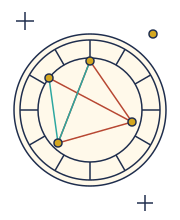
Take the twelve signs and group them by the four sets of three that sit at 120 degrees from each other. Each of those four groups gets its own set of ruling planets, and which of those planets is in charge depends on whether the chart is a day chart or a night chart.
That is triplicity rulership, the third of the five essential dignities. The Greeks called the groups trigonon, triangles, and the rulers trigonokrator. Brennan uses the Medieval word "triplicity" specifically to keep the group separate from the trine aspect, which the Greek astrologers called by the same word.
In early texts such as Dorotheus the triplicity lords work almost as an alternative form of sign rulership, doing many of the same jobs as the domicile lord. In Valens they are used more restrictively, for specific techniques.
| Triplicity | Signs |
|---|---|
| First | Aries, Leo, Sagittarius |
| Second | Taurus, Virgo, Capricorn |
| Third | Gemini, Libra, Aquarius |
| Fourth | Cancer, Scorpio, Pisces |
Notice that the table says first, second, third and fourth. Not fire, earth, air and water. Keep reading, because that is deliberate.
The Elements Are Not A Universal Hellenistic Doctrine
You already supplied the words fire, earth, air and water while reading that table. Everybody does. Hold on to them for a moment, because a large part of the tradition does not agree that they belong there.
Brennan is emphatic about this, and it is one of the more surprising findings in the whole subject. The majority of surviving Hellenistic sources are conspicuously silent about assigning the four elements to the triplicities.
- Sources that do assign them: Valens (Anthology, 1, 2), Firmicus (Mathesis, 2, 10), Hephaistio (Apotelesmatika, 3, 7: 7), Julian of Laodicea (CCAG 4, p. 152: 21-23) and Rhetorius (Compendium, 3).
- Sources that do not: Manilius, Thrasyllus, Antiochus, Dorotheus, Manetho, Ptolemy, Porphyry, Paulus, the Anonymous of 379 and Olympiodorus.
Look at that second list. Dorotheus, the chief source for the triplicity rulers themselves, says nothing about elements. So does Ptolemy, who wrote the rival scheme. The two people most responsible for this doctrine never once tell you Aries is a fire sign. The earliest source for the elemental associations is Valens, working in the middle of the second century CE, a point first made by Robert Hand.
Where the sources do interpret the elements, the readings are strikingly literal. Valens uses them for manner of death: a significator in Cancer and death by drowning in a bath (Anthology, 2, 41: 49), and Mars in Leo and death by fire (2, 41: 66). Not exactly "water signs are intuitive."
None of this means you should stop calling Aries a fire sign. It means anyone presenting the four elements as bedrock Hellenistic doctrine is overstating the record, and that the triplicity rulers can be held without them, as they originally were.
The Dorothean Scheme
This is the standard set, used throughout the tradition. Each triplicity has three rulers: a day ruler, a night ruler and a cooperating or participating ruler. The day and night rulers swap places depending on the chart. The cooperating ruler never changes.
| Triplicity | Day ruler | Night ruler | Participating ruler |
|---|---|---|---|
| Fire: Aries, Leo, Sagittarius | Sun | Jupiter | Saturn |
| Earth: Taurus, Virgo, Capricorn | Venus | Moon | Mars |
| Air: Gemini, Libra, Aquarius | Saturn | Mercury | Jupiter |
| Water: Cancer, Scorpio, Pisces | Venus | Mars | Moon |
The two main sources are Dorotheus, Carmen, 1, 1: 2-4, and Valens, Anthology, 2, 1. Hephaistio quotes Dorotheus directly from the original verse text at Apotelesmatika, 1, 6, and Rhetorius carries it at Compendium, 9. Brennan notes that although it is called the Dorothean scheme, Dorotheus was probably not its originator, since it is standard throughout the tradition. Three independent modern printings agree in all four triplicities and all three positions.
One internal disagreement is on the record. Dorotheus says Mercury may have some role in the earth triplicity (Carmen, 1, 1: 3), but Brennan says it is never brought into use in any tangible way. Valens does not mention Mercury for earth at all, but says that because Mercury is "common," koinos, he works with and assists all the triplicity rulers (Anthology, 2, 1: 10). Mercury, refusing to be sorted, as usual.
Lilly's Scheme, Taken From Ptolemy
Ptolemy wrote an alternative and it was never widely adopted in the Hellenistic or Medieval traditions. William Lilly is the notable later adopter, and he cites Ptolemy for it.
| Triplicity | Diurnal ruler | Nocturnal ruler | Participating ruler |
|---|---|---|---|
| Fire: Aries, Leo, Sagittarius | Sun | Jupiter | none in this scheme |
| Earth: Taurus, Virgo, Capricorn | Venus | Moon | none in this scheme |
| Air: Gemini, Libra, Aquarius | Saturn | Mercury | none in this scheme |
| Water: Cancer, Scorpio, Pisces | Mars by day and by night | Mars by day and by night | none in this scheme |
George states that Ptolemy changed the rulers of the water triplicity and eliminated the cooperating rulers altogether, and that Lilly's work derives directly from the Ptolemaic tradition. Louis says the same, citing Lilly, Christian Astrology, p. 104.
Exactly How The Two Schemes Differ
The difference is smaller than it looks, and it is sharply located.
- Fire, earth and air have identical day and night rulers in both schemes. Sun and Jupiter for fire, Venus and Moon for earth, Saturn and Mercury for air. No disagreement at all in the primary rulers of three of the four triplicities.
- Lilly drops the participating ruler entirely. Saturn for fire, Mars for earth and Jupiter for air simply do not appear. Three planets lose a dignity they hold under Dorotheus.
- Water is the only triplicity where the actual rulers differ. Dorotheus gives Venus by day, Mars by night, Moon participating. Lilly gives Mars by day and by night, and neither Venus nor the Moon holds any triplicity dignity in water.
- The consequence for scoring is not small. Under Dorotheus every triplicity has three planets holding dignity there; under Lilly, one. Venus in Pisces scores triplicity dignity under Dorotheus and none under Lilly, so the same chart can produce different almutens depending on the scheme loaded.
One point stays open. Brennan reports Ptolemy remarking in passing that Venus becomes a co ruler of water by day and the Moon by night. Lilly's table as Louis presents it has no such co rulers. It cannot be resolved from these sources.
Why Sect Decides Which Ruler Is Active
The day and night ordering is not decoration. It is the load bearing part.
George's framing is that the system rests primarily on the four groupings and secondarily on sect. Fire and air are composed of diurnal masculine signs and take the diurnal planets as lords; earth and water are nocturnal feminine signs and take the nocturnal planets. So the Sun, Jupiter and Saturn do better in fire and air, and the Moon, Venus and Mars in earth and water.
Louis is precise about what changes with sect and what does not, and this is the part people get backwards. In Dorotheus' system all three planets ruling a triplicity have dignity and score points regardless of whether the birth was by day or by night. What changes is the order. In a day chart the day ruler is first and the night ruler second; in a night chart the night ruler is first and the day ruler second. The participating ruler always comes last.
Ptolemy's own rationale has three stated criteria (Tetrabiblos, 1, 19). Only diurnal planets may rule the masculine fire and air signs and only nocturnal planets the feminine earth and water signs. A planet with its domicile or exaltation in a triplicity is eligible to rule it. A planet with both carries more weight.
Brennan's verdict is that the rationale is "a little bit too clean to be an accident" and still not entirely consistent. The Moon should be night ruler of water rather than Mars, since she is elsewhere considered more nocturnal. Mercury is admitted to air despite neutral sect but rejected as primary ruler of earth even though he holds both domicile and exaltation there. And it is not clear why Jupiter cooperates in air rather than the Sun, which Brennan flags with the words "for unknown reasons."
The Joys, And Where The Elements Probably Came From
Brennan's conclusion is that the dignity rationale was not the original one, and that the missing factor is the scheme of planetary joys.
| House | Ancient name | Planet that rejoices there |
|---|---|---|
| 1 | the rising | Mercury |
| 3 | Goddess | Moon |
| 5 | Good Fortune | Venus |
| 6 | Bad Fortune | Mars |
| 9 | God | Sun |
| 11 | Good Daimon | Jupiter |
| 12 | Bad Daimon | Saturn |
George's observation on the figure is checkable against the table, so check it. The Sun, Jupiter and Saturn, the diurnal lords of fire and air, all rejoice above the horizon. The Moon, Venus and Mars, the nocturnal lords of earth and water, all rejoice below it. Mercury, the common planet, rejoices in the first house, which straddles the horizon. Of course it does.
Robert Schmidt first observed that the triplicity lords cluster around the four angular houses. The fire lords Sun and Jupiter flank the tenth, with Saturn adjacent to Jupiter. The air lords Saturn and Mercury sit near the first, with Jupiter adjacent to Saturn. The earth lords Venus and the Moon surround the fourth, with Mars adjacent to Venus. And Mars, a water lord, is next to the seventh. Water is the only triplicity that does not close neatly, and it is the same one Ptolemy rewrote. Make of that what you will.
Brennan built the elemental derivation on top of that clustering, and George reports both. Under Aristotle's doctrine of natural place, fire is lightest and rises highest, air settles below fire, water sinks and rests on earth, and earth is heaviest and lies lowest. Map that onto the wheel: Sun and Jupiter at the top belong to fire at the heights, Venus and the Moon at the bottom to earth at the depths, Mercury and Saturn at the Ascendant to air, which rises, and Mars to water, which sinks. This is a modern reconstruction, not an ancient statement, and it is the strongest available answer to where the element names came from.
A Third Scheme, Morin's
In the seventeenth century Morin de Villefranche reviewed the literature, decided the schemes of Ptolemy and Dorotheus were not rational, and built his own on the premise that triplicity rulers should follow domicile and exaltation rather than sect.
| Triplicity | Diurnal | Nocturnal | Participating |
|---|---|---|---|
| Fire | Sun | Mars | Jupiter |
| Air | Saturn | Venus | Mercury |
| Water | Jupiter | Moon | Mars |
| Earth | Mercury | Saturn | Venus |
Day rulers hold both domicile and exaltation in the triplicity, night rulers rule its cardinal sign, and the participating ruler rules one of the three signs but is neither exalted there nor lord of the cardinal sign. Louis calls it "logical and elegant" and leaves whether it works to the reader. Three incompatible schemes exist, and no source here picks between them.
What Triplicity Dignity Does
George's reading is that a planet in its own triplicity is supported by its natural environment, has greater stability, and greater power to bring its significations about in ways beneficial to material well being. Her Medieval image, from Bonatti, Book of Astronomy, 2, 2, 19, is precise about the kind of support: a person among his allies and followers, who follow and obey him but are not related by kinship. That last clause is what separates triplicity from domicile, the family estate. Domicile is the people who have to take you in. Triplicity is the people who show up anyway.
The lords also carry techniques of their own. The triplicity lords of the sect light, the Sun by day or the Moon by night, were an important Hellenistic technique for judging the overall eminence and fortune of a life. Dorotheus often used the three lords of a sign rather than its domicile lord for judgments about that house, saying that everything decided and indicated comes from the lords of the triplicities (Carmen, 1, 1: 8). And the Hellenistic astrologers used the first two lords to rule the first and second parts of life, with the changeover timed to the planetary periods of the lords and the ascensional times of their signs (Valens, Anthology, 2, 2); the Arabic and Medieval astrologers added the third lord for a third part.
What To Actually Go Do
Find your sect light first. Sun if you were born in the day, Moon if you were born at night. Look at the sign it is in, take that sign's triplicity from the Dorothean table, and write down all three lords in order: first lord, second lord, participating lord.
That is the Hellenistic life eminence technique in its opening move, and the two planets at the top of your list are the ones the tradition would have you look at for how the first and second parts of a life go. Where are they? What condition are they in? Who do they answer to?
Then, for the fun of it, do the same sign under Lilly's table and see whether the answer changes. If your sect light is in a water sign, it will.
Frequently Asked Questions
Which Triplicity Scheme Should I Use?
Dorothean for the Hellenistic tradition, since it is the standard set and three sources agree on it exactly. Lilly's for seventeenth century horary in his idiom. The choice changes dignity scores, so make it deliberately.
Do All Three Triplicity Lords Count In A Day Chart?
Under Dorotheus, yes. Louis states that all three hold dignity and score regardless of sect. Sect changes the order of precedence, not whether a planet has the dignity.
What Is A Participating Or Cooperating Ruler?
The third lord of a triplicity, which stays in place in both day and night charts. It always comes last in the ordering. Lilly's scheme does not have one.
Are The Four Elements Ancient?
The groupings of three signs are. The names fire, earth, air and water attached to them are attested in Valens, Firmicus, Hephaistio, Julian and Rhetorius, and are absent from Dorotheus, Ptolemy, Porphyry, Paulus, Manilius, Thrasyllus and Antiochus. Valens is the earliest source for them.
How Is Triplicity Different From Domicile?
Bonatti's image is the cleanest answer: domicile is family and estate, triplicity is allies and followers who obey but are not kin. Both give a planet backing, and it is not the same backing.
Recommended Reading
Book links below are Amazon affiliate links. As an Amazon Associate I earn from qualifying purchases, at no extra cost to you.
- Dorotheus, Carmen, 1, 1: 2-4 and 1, 1: 8, the primary source for the standard scheme.
- Vettius Valens, Anthology, 2, 1 and 2, 2; and 1, 2 for the elemental assignment.
- Ptolemy, Tetrabiblos, 1, 19, for the alternative scheme and the dignity rationale.
- Hephaistio, Apotelesmatika, 1, 6, quoting Dorotheus from the verse text. Rhetorius, Compendium, 9.
- Chris Brennan, Hellenistic Astrology (2017), for the elements finding and the rationale critique.
- Demetra George and Chris Brennan, Ancient Astrology in Theory and Practice, for the joys, the Schmidt clustering and the Bonatti image at Book of Astronomy, 2, 2, 19, trans. Dykes.
- Anthony Louis, Horary Astrology, for Lilly's table, the day and night ordering, and Morin.
Continue Learning
Next: planetary bounds and terms and sect in astrology.