
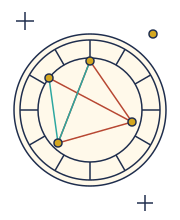
Every other chart in the sky is led by the Sun, which takes a year to go around and moves about a degree a day. Yours is led by the Moon.
The Moon changes sign every two and a half days. It is the fastest body in the chart by an enormous margin, it governs the body and the emotional life, and in a night chart it is the thing everything else answers to. A chart led by the Moon is a chart organised around adaptation, timing and response rather than around a fixed direction. That is a specific way of being built, and it is worth reading as such before any of the planetary assignments are applied.
Then there is the second surprise, which is that the planet most likely to act in your interest in a nocturnal chart is Mars.
The technical word is nocturnal, and it sets the terms for how four of the seven traditional planets will behave for the whole of a life. In a night chart the Moon leads. Venus is the benefic that works best. Mars is the malefic that behaves. Saturn is the one carrying the difficulty.
How To Tell You Have One
Find the Sun and find the horizon axis, the line running from the Ascendant on the left of the wheel to the Descendant on the right. If the Sun sits in the lower half, below that axis, the chart is nocturnal.
Stated precisely: the chart is nocturnal once the Sun has set below the exact degree of the Descendant, and it stays nocturnal until the Sun rises above the exact degree of the Ascendant. Use the degrees rather than the house, because with whole sign houses the Sun can sit in the first house and still be below the Ascendant degree.
Two caveats attach to that rule. The ancient texts generally do not specify the moment a chart switches from one to the other; the Ascendant and Descendant degree rule is Chris Brennan's rule of thumb rather than a cited ancient source. And the twilight question is open: there may be a span of degrees below the horizon where the Sun still makes it daytime, and Brennan states plainly that the range is unestablished and remains a matter of research. A birth within a degree or two of sunset or sunrise should be read both ways before you commit.
The Moon As Your Sect Light
The luminary leading the team that matches the chart is called the sect light. In a nocturnal chart that is the Moon, and this changes where you look first.
The Moon's sign, the house it occupies, its phase and the condition of its domicile lord all carry additional weight in a night chart, in the same way that the chart ruler carries weight for the Ascendant. Questions of vitality, direction and the overall shape of a life route through the Moon here.
It also changes what a Moon aspect is worth. In a nocturnal chart, a planet that aspects the Moon is aspecting the leader of the chart's own sect, and its testimony gets read accordingly. Aspects to the Moon stop being footnotes about mood and start being statements about the chart's command structure.
The Sun in a night chart is still the Sun. It still signifies the father, the vocation and the place where the native is visible. It leads the other team.
Mars, The Malefic Of Sect
Mars is nocturnal, so in a night chart Mars is on the home team. A malefic of the sect has its negative significations suppressed and its more constructive significations brought out.
Constructive Mars is decisive, fast, willing to cut, willing to start, and unbothered by conflict. In a night chart those qualities are pointed in the native's direction. The house Mars occupies often marks where the person can act without hesitating and be right to, and the houses Mars rules tend to be handled with more competence than the label "malefic" would suggest.
That is worth saying plainly, because the modern reputation of Mars is built almost entirely on its out of sect behaviour. If you were born at night, you have the other one.
Mars is still Mars. It still runs hot and it still breaks things when it is badly placed by sign or badly aspected. Sect does not remove that; it changes whose side the heat is on.
Venus, The Benefic Of Sect
Venus is a nocturnal planet, so in a night chart it is of the sect, the Greek tes haireseos, and the texts say it rejoices. A benefic in that condition becomes more benefic, with its positive significations coming to the forefront.
The most positive planet in a night chart is Venus. That is the working rule, and Brennan notes that while mitigating factors can alter it, for the most part it holds despite them.
What that means in practice is that Venus's house and the houses Venus rules are the parts of the chart most likely to resolve in the native's favour. Relationships, money, art, pleasure, and whatever else the specific placement governs, all of it operates with the benefit of the doubt. If you are looking for the most reliable source of good in a nocturnal chart, start at Venus and work outward through what it rules.
Jupiter in a night chart is the diurnal benefic in a nocturnal chart, which puts it in the middle of the spectrum. Still moderately positive, less inclined to do good than it would be by day. So the so called lesser benefic outranks the greater one here, which tells you how much those titles are actually worth.
Saturn, Contrary To The Sect
Saturn is a diurnal planet, so in a night chart Saturn is contrary to the sect (para ten hairesin). A malefic in that condition becomes more malefic, acting in a manner that is more problematic and potentially destructive.
The most difficult placement in a night chart is Saturn. This is the one placement in the scheme that reliably describes real weight, and it deserves to be named without either softening it or dramatising it.
What it describes is delay, restriction, and cost that arrives before the reward does, concentrated in the house Saturn occupies and the houses it rules. Things in that territory take longer than they take other people. The native tends to arrive at them later, having paid more, and often having assumed for years that the difficulty was personal rather than structural.
It is not a verdict on a life. Saturn contrary to sect is a description of tempo and of price, and both of those are workable once they are recognised. The most common practical error is treating a Saturn area as closed when what it actually needs is a longer runway. Look at Saturn's own dignity, its aspects to the benefics, and the condition of its domicile lord, including any mutual reception it carries, before you decide how heavy it really sits. See essential dignity for that assessment, and Saturn returns for when the subject comes up by transit.
The Four Planet Ranking, Night Chart
| Position on the spectrum | Planet | Condition |
|---|---|---|
| Most positive | Venus | Nocturnal benefic, of the sect |
| Middle, moderate | Jupiter | Diurnal benefic, contrary to the sect |
| Middle, moderate | Mars | Nocturnal malefic, of the sect |
| Most negative | Saturn | Diurnal malefic, contrary to the sect |
Mercury sits outside this and the tradition never settled where it belongs. Ptolemy and Porphyry make it nocturnal when it is an evening star setting after the Sun, Valens makes its sect depend on the ruler of the bounds it occupies, the Michigan Papyrus has Mercury take the sect of the chart, and Rhetorius calls it neutral. The four positions are laid out at sect in astrology.
One boundary on the ranking. Sect is a qualitative factor, not a quantitative one. It alters the benefic or malefic character of a planet and not how strong or prominent that planet is. A Venus of the sect in the twelfth is still of the sect and still quiet. A Saturn contrary to sect on the Midheaven is loud regardless.
The Hemisphere Condition In A Night Chart
There is a second, additional condition under which planets are said to rejoice, and it reads this way for a nocturnal chart.
Nocturnal planets rejoice above the horizon in a night chart. Diurnal planets rejoice below it.
So the Moon, Venus and Mars prefer the upper half of the wheel, and the Sun, Jupiter and Saturn prefer the lower half. The halves are set by the Ascendant and Descendant degrees. Valens gives the condition at Anthology, 3, 5: 2.
A nocturnal chart with the Moon in the tenth and Venus in the eleventh has its sect light and its best benefic both in the preferred half. A nocturnal chart with Saturn in the tenth has the hardest planet in the chart contrary to sect and outside its preferred hemisphere at the same time.
How much this counts for is contested. Brennan argues that the rejoicing conditions did not carry anything like the emphasis in the Hellenistic tradition that sect membership itself did, and that the Medieval practice of awarding a point to each of the three conditions flattened a real hierarchy. Test the hemisphere condition as a refinement rather than treating it as an equal term.
What To Actually Go Do
Start with the Moon and treat it as the chart's lead rather than as the mood section. Sign, house, phase, and then the condition of its domicile lord. Write those four things down in order. That is the spine of a nocturnal chart and most readings you have had probably buried it under the Sun.
Then go find Mars and read its house as an ability rather than a hazard. Where can you move first, decide fast, and be right to? A night chart usually has a clear answer and it is usually somewhere the person has been talked out of trusting themselves.
Finally, look at Saturn and name the tempo. Not "what is wrong here," but "how long does this territory actually take, and what has it cost so far." That is the question the placement is built to answer.
Frequently Asked Questions
What Is A Night Chart In Astrology?
A night chart, or nocturnal chart, is one where the Sun was below the horizon at birth, meaning below the axis between the Ascendant and Descendant degrees. The Moon leads the planetary sect in a chart like this.
Which Planets Are Favoured In A Night Chart?
Venus is the most positive planet in a night chart. Mars, although a malefic, is of the sect and has its constructive significations brought forward. Jupiter is moderately positive and Saturn is the most difficult.
What Does Saturn In A Night Chart Mean?
It means Saturn is contrary to the sect, so its more problematic significations come forward. In practice that reads as delay and cost concentrated in the house Saturn occupies and the houses it rules. It is a statement about tempo and price, not a verdict.
Is Mars Really Easier In A Night Chart?
Yes, in the sense the doctrine means. A malefic of the sect has its negative significations suppressed and its constructive ones brought out, so Mars in a night chart tends to act in the native's interest rather than against it.
What Does The Moon Being My Sect Light Change?
It makes the Moon the luminary the chart is organised around. Its sign, house, phase and domicile lord all carry extra weight, and aspects to the Moon are aspects to the leader of the chart's own sect.
I Was Born Just After Sunset. Which Chart Do I Have?
Compare the Sun's degree to the Descendant degree. If they are within a degree or two, the classification is genuinely open, because the twilight boundary was never established in the tradition. Read it both ways and see which reading the life answers to.
Recommended Reading
Book links below are Amazon affiliate links. As an Amazon Associate I earn from qualifying purchases, at no extra cost to you.
- Chris Brennan, Hellenistic Astrology: The Study of Fate and Fortune (2017), for the sect doctrine, the four planet ranking, the day and night determination rule, and the argument about the weight of the rejoicing conditions.
- Valens, Anthology, 3, 5: 2, for the hemisphere rejoicing condition; 7, 2: 2, for the familiar and foreign relation to the sect.
- Firmicus, Mathesis, 3, 2: 16-17 and 3, 3: 18-19, trans. Bram, for placements delineated differently by night than by day.
- Hephaestio, Apotelesmatika, 1, 2: 9, on the division of the planets into two sects.
- Ptolemy, Tetrabiblos, 1, 7: 1, and Porphyry, Introduction, 4, on Mercury as an evening star.
- Dorotheus, Carmen, 1, 7: 23-4 and 1, 26: 29, for the sect rule stated correctly, as against the reversed line at 1, 6: 4 that Brennan judges a scribal error.
Continue Learning
Next: day chart in astrology and sect in astrology. For the full ranking, see benefics and malefics in astrology, and for where the whole scheme originates, the Thema Mundi.