
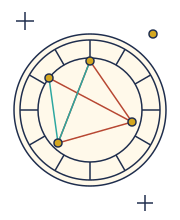
A synastry house overlay happens when one person's planet falls in a house of another person's birth chart. The planet person brings a function. The house person experiences that function in a particular area of life.
Here is the part that gets quietly dropped. There are two overlay maps in every relationship and they are not versions of each other. A's Venus may fall in B's fifth house while B's Venus falls in A's tenth. Same Venus, same pair of people, two entirely different stories, and most readings only ever run one direction. Usually the direction that was more fun to look up.
There is also an asymmetry in the data. An overlay needs an accurate birth time from the house person, because it is their houses being used. Flip the wheel and the requirement flips with it.
And before any of it, the rule that governs all synastry work. Arroyo opens his synastry outline by saying the individual chart comes first, because a person may be compatible with nobody and no comparison means anything until you know that. Steven and Jodie Forrest reach the same conclusion independently in Skymates. An overlay lands on a chart that already exists. Read it first. See capacity for relationship in a birth chart.
How To Read Any Overlay
Four questions, every time.
- What does the planet bring?
- What topics belong to the house?
- What is the planet's natal condition?
- What aspects and rulerships repeat the theme?
Venus does not become a different Venus on the way into someone else's chart. A natal Venus already tangled up with Saturn or Mars brings those relationships in with it, and that is usually the thing that decides how the overlay actually behaves.
First-house Overlays
The first house concerns body, identity, appearance and approach. Planets here can feel immediate and personal.
The Sun may increase recognition or visibility. Venus can support attraction and appreciation. Mars can energize, sexualize, compete with, or straightforwardly irritate the house person's self-expression. Saturn may stabilize identity, or make the house person feel judged and restrained.
Second-house Overlays
The second concerns money, possessions, income, livelihood and resources.
Venus or Jupiter may support earning, gifts and shared values. Mars can increase spending or motivate financial action. Saturn can formalize budgets and obligations. This house is not only "self-worth," whatever the last decade of astrology content has told you. Look for the concrete resource effects.
Third-house Overlays
The third concerns communication, siblings, neighborhood, short travel and everyday learning.
Mercury here often stimulates conversation and exchange of information. Mars may create debate or hurried decisions. The Moon can make daily communication emotionally familiar. This is the house where a relationship becomes embedded in the house person's local life.
Fourth-house Overlays
The fourth concerns home, parents, roots, land, privacy and foundations.
Moon or Venus overlays can feel domestic and familiar. Saturn can bring commitment to home and family, and also duty or constraint. Pluto may intensify private and ancestral material. A fourth-house overlay is not evidence that two people will live together.
Fifth-house Overlays
The fifth concerns pleasure, romance, sex, creativity, performance, children and risk.
Sun, Venus, Mars or Jupiter here can increase play, attraction, creativity and enjoyment. Saturn may make recreation serious, or connect the bond with responsibility for children. The fifth supports dating and pleasure. Committed partnership belongs more directly to the seventh.
Sixth-house Overlays
The sixth concerns labor, illness, service, routines, obligations, subordinates and small animals.
Mercury may organize daily tasks. Mars can increase workload or conflict over chores. Saturn may make the relationship highly dependable and also burdened by duty. Do not romanticize a sixth-house overlay when the lived pattern is unequal labor.
Seventh-house Overlays
The seventh concerns partners, contracts, clients, competitors and open opponents.
The Sun, Moon, Venus or chart ruler here can create strong partner recognition. Mars may add pursuit and conflict. Saturn may support formal commitment, or create fear and delay. The house activates consequential one-to-one relating. It does not promise marriage, and the opponents are listed there for a reason.
Eighth-house Overlays
The eighth concerns other people's resources, debt, taxes, inheritance, dependency, fear and mortality.
Modern synastry loves to make this one entirely about sex, but the financial and dependency topics are essential and they are the older reading. Venus may soften exchange. Saturn can formalize debt or obligation. Pluto may intensify power negotiations. Vulnerability is not automatically closeness.
Ninth-house Overlays
The ninth concerns religion, philosophy, higher education, law, divination, publishing and long travel.
Jupiter may support shared learning and belief. Mercury can stimulate study and teaching. Saturn can formalize education, or produce ideological rigidity. The planet person may expand the house person's worldview, or challenge it, and those often feel identical from inside.
Tenth-house Overlays
The tenth concerns career, reputation, authority, public action and visibility.
The Sun or Jupiter can amplify confidence and recognition. Saturn may professionalize the bond or create public responsibility. Mars can energize ambition or competition. A partner's planet here can affect how the house person is seen by people who have never met the partner.
Eleventh-house Overlays
The eleventh concerns friendship, allies, groups, patrons, hopes and gains.
Venus and Jupiter can support friendship and shared community. Mercury may connect networks. Saturn can make an alliance durable and selective. Strong eleventh-house overlays can carry a relationship on genuine friendship, which is less romantic to write about and considerably more load-bearing.
Twelfth-house Overlays
The twelfth concerns isolation, hidden enemies, confinement, institutions, withdrawal and matters outside ordinary visibility.
Modern readings add the unconscious, spirituality and hidden feelings. Neptune here may increase empathy or confusion. Saturn may create secrecy, or shared responsibility inside institutions. Mars can expose hidden conflict. A twelfth-house overlay does not prove a past life or a secret affair.
Which Person Feels The Overlay More
Both people participate, and not identically. The planet person expresses the planetary function. The house person experiences where it lands. Awareness, natal aspects and context all affect who notices it first and who notices it hardest.
What To Actually Go Do
Build the second map, since you almost certainly already built the first one.
Take the person whose houses you have been reading, and put their planets into your chart instead. Sun through Saturn is enough. Write down which house each one lands in.
Then compare the two maps side by side and look for one thing: a house that shows up on both sides. If their planets cluster in your fourth and yours cluster in their fourth, that is a repetition, and repetition is the strongest signal in synastry short of an exact aspect. If the two maps point at completely different houses, that is also worth knowing, because it usually means the two of you have been describing different relationships to each other in good faith.
Recommended Reading
Book links below are Amazon affiliate links. As an Amazon Associate I earn from qualifying purchases, at no extra cost to you.
- Chris Brennan, Hellenistic Astrology, chapters on the twelve places and rulers.
- Robert Pelletier, Planets in Houses.
- Kevin B. Burk, Astrological Relationship Handbook.
- Steven Forrest and Jodie Forrest, Skymates.
- Stephen Arroyo, Relationships & Life Cycles, "Systematic Outline of Synastry," on reading each chart before comparing them.